Featured

About

The Egerton Museum of The Divine Comedy is the museum of the medieval manuscript Egerton MS 943 titled La Divina Commedia. The manuscript was originally created in Northern Italy in either Emilia or Padua during the first half of the 14th century. It now resides in the British Library in London thanks to it being purchased in 1842 with the Bridgewater fund for 12,000 euros. The manuscript is written in Italian and includes commentary in Latin.

Dante Alighieri

“Never was there a poet who possessed to an equal degree the eye of the painter.”

Sarolea, Charles. From the Preface to “The Pictorial Presentations in Dante’s Divine Comedy” by Ludwig Volkmann (vi)
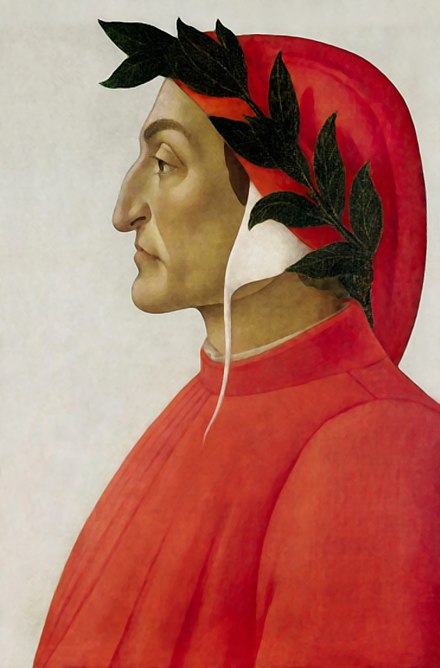
https://en.wikipedia.org/wiki/Dante_Alighieri

La Divina Commedia was written by Dante Alighieri, who became a very famous Italian poet in the late Middle Ages. According to Ricardo Quinones, it took Dante more than ten years to write the epic, and its influence has carried on over the course of more than 650 years. Dante’s Divine Comedy is a long narrative poem, or epic poem, that consists of three parts: Inferno, Purgatorio, and Paradiso. The section Inferno refers to Hell, Purgatorio refers to Purgatory, and Paradiso refers to Paradise, or Heaven. Although this is not a religious text, it does incorporate many religious ideas about the three realms of the dead. The basis of the poem is Dante’s journey through each of the realms led first by the Italian poet Virgil through Hell and Purgatory and then by Beatrice, who was Dante’s ideal woman, to Heaven. Before touring the exhibits, we recommend that our visitors watch these videos that summarize the plot of each of the three sections.

Summary of Dante’s Inferno
Summary of Dante’s Purgatorio
Summary of Dante’s Paradiso

Size

The manuscript’s dimensions are 390 x 260 mm. In order to better understand the size of this manuscript, it has been compared to the size of an iPad and a standard sheet of paper below. In this image, a normal sheet of paper is seen in yellow with its size being 297 x 210 mm, the manuscript is depicted in green with its size being 390 x 260 mm. Finally, the iPad is on the right with its size of about 243 x 13 mm. So, the manuscript is significantly bigger than an iPad and a good bit larger than a standard sheet.
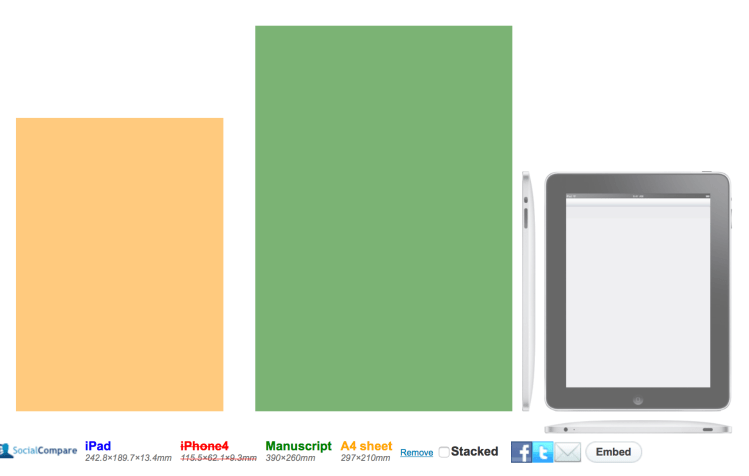
http://socialcompare.com/en/tools/compare-sizes

What’s Inside

In addition to the main text, other things that can be found throughout this manuscript are illustrations (261 small miniatures in gold and color), circular diagrams of Heaven and Hell, gold illumination, rubrication, large decorated and inhabited initials, Latin commentary in the margins, and more. Each of these are exhibited throughout the museum, in addition to the materials and structure of the manuscript.

“The ‘Divine Comedy’ is not only the summa of all the wisdom of his time, it is not only a chronicle of local and general history, it is, moreover, a marvellous gallery of pictures and a museum of sculpture.”

Sarolea, Charles. From the Preface to “The Pictorial Presentations in Dante’s Divine Comedy” by Ludwig Volkmann (vi)

Towards the beginning of the manuscript, there is a certificate of its value that was signed in June of 1815 by D. Pietro Zani and two others at the Library of Parma.
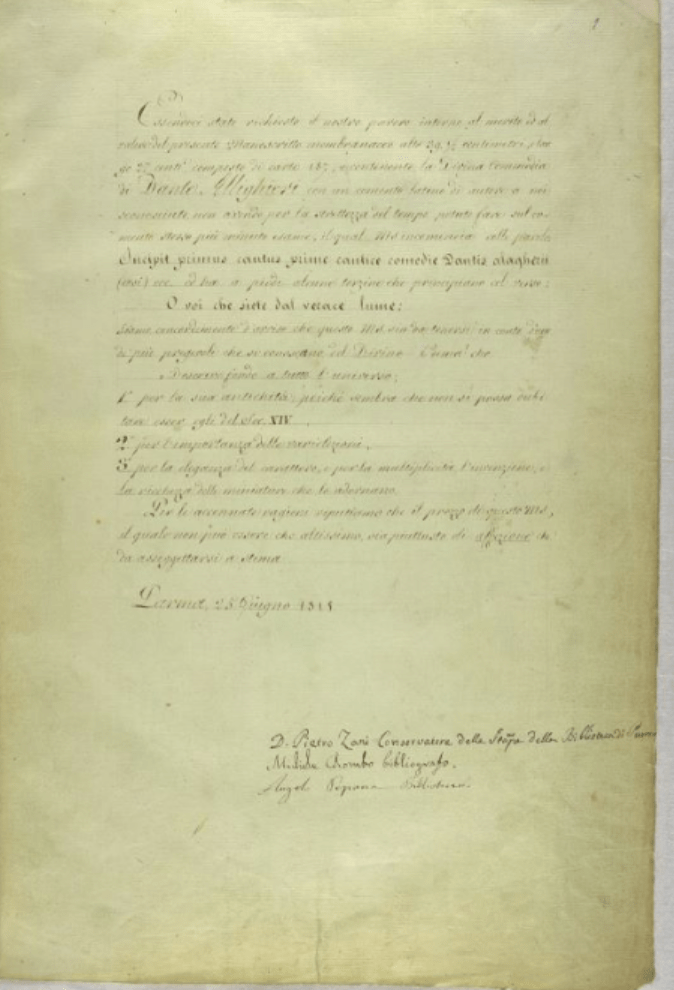
This image is folio 1r of the manuscript. It is the certificate from 1815 signed by D. Pietro Zani, whose name is found at the bottom of the page.

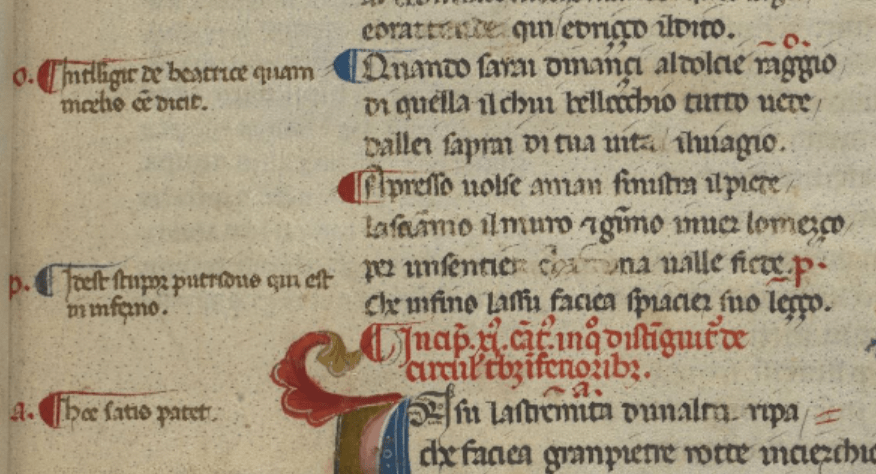
Before the start of Purgatorio, there is a chapter list; the only one included in the poem.
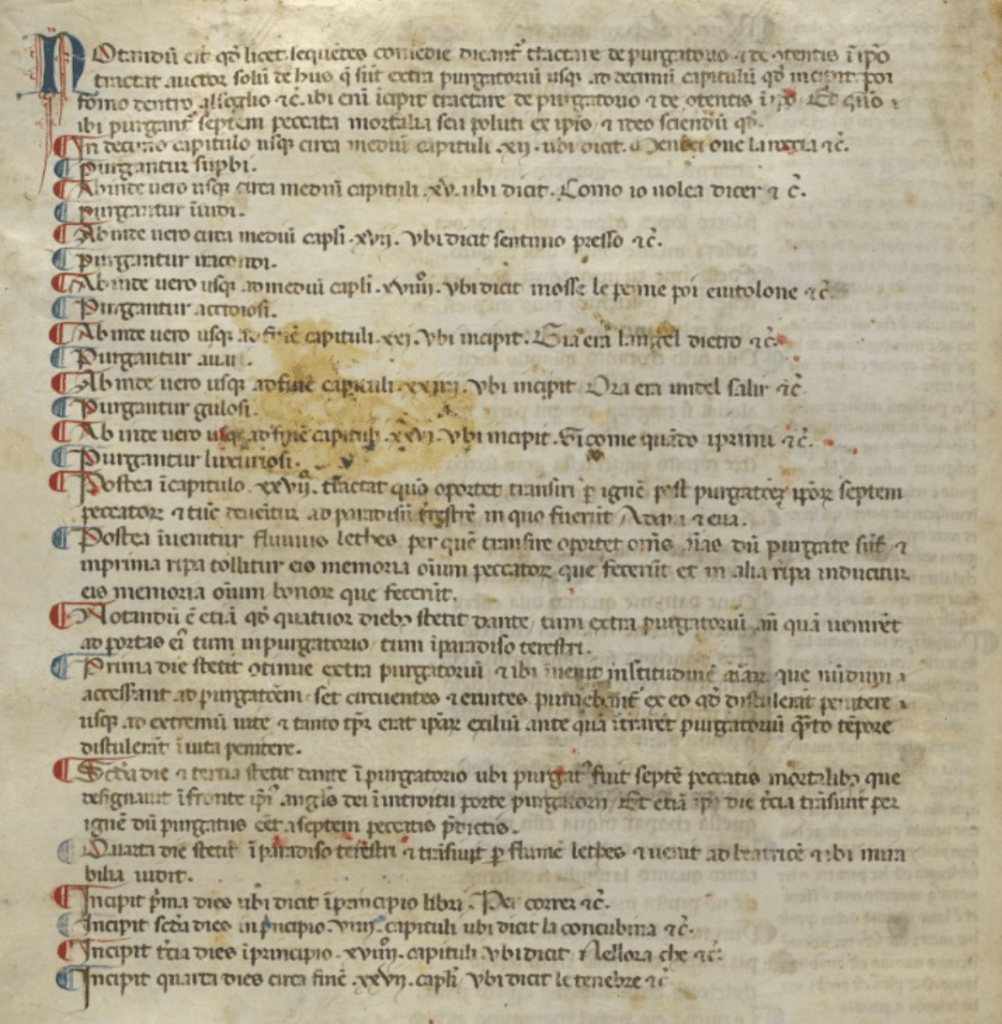
Chapter list for Purgatorio, Egerton MS 943, f.

At the end of the manuscript, there are added verses by Jacopo Alighieri (Dante’s son) that serves as a sort of introduction to his father’s work.
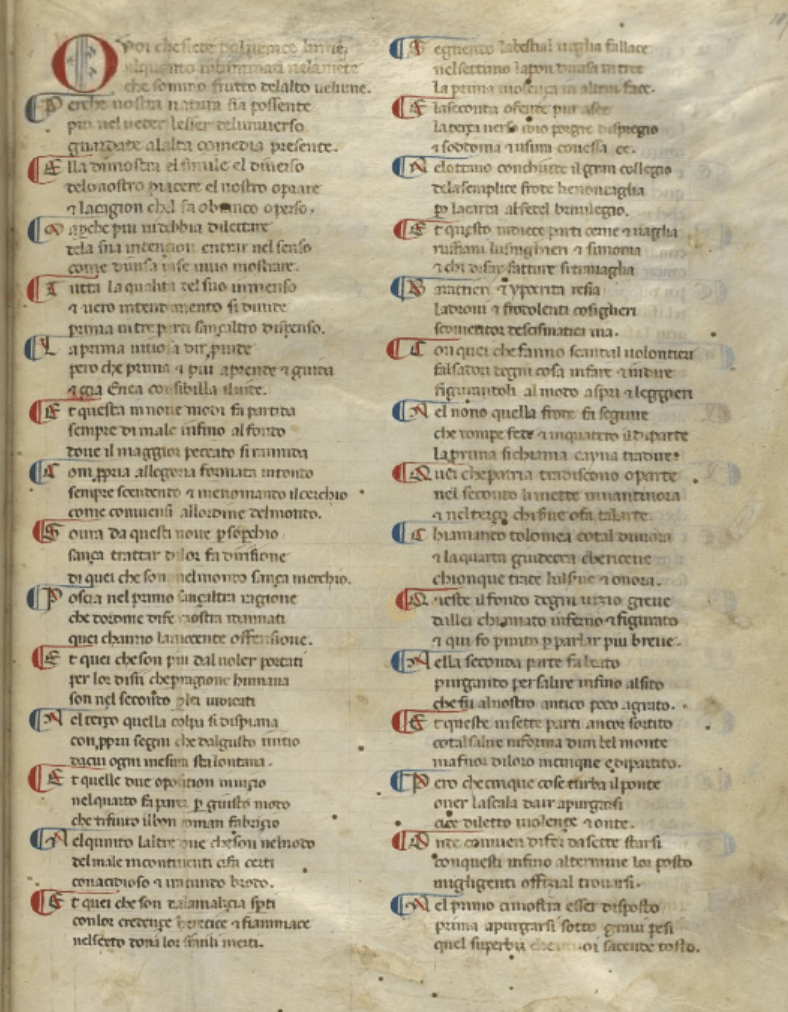
The first of the added verses by Jacopo Alighieri, Egerton MS 943, f. 187r

Physical Damage

This manuscript is quite damaged. Many of its pages contain evidence of water damage, stains, fading, and ink deterioration. Some of the columns of text are so damaged that they cannot be read. The commentary in the margins has also experienced a significant amount of damage, with whole chunks of text missing. In addition, two of its pages were excised from the Paradiso section. Although there are also several indications that the text had to be corrected, the damage is so intense that much of it cannot be fixed.
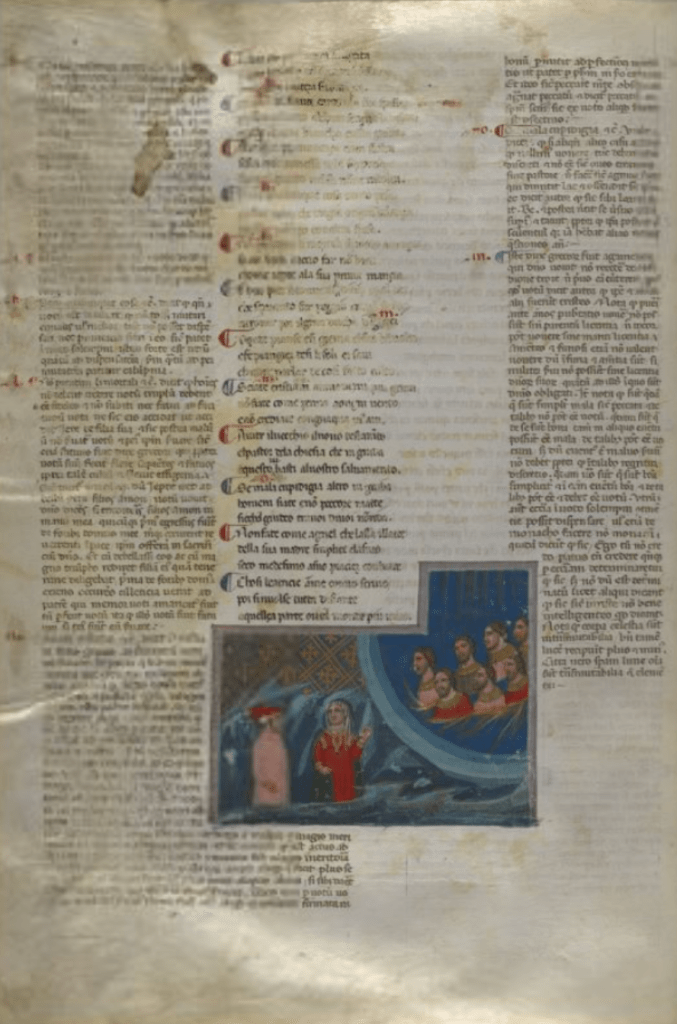
Damaged page from Paradiso, Egerton MS 943, f. 137v

What are its functions?

Dante’s poem explores the ideas about the afterlife by creating a fictional journey through the realms. The ideas that are used to tell this story come from medieval Christianity. In the Middle Ages, religion shaped the way people lived their everyday lives, so it is not a surprise that this would become a very popular work despite the fact that works of literature were only just beginning to gain popularity at the time.
Sources

Clemens, R. and T. Graham, “Introduction to Manuscript Studies” (London: Cornell University Press, 2007).

Sarolea, Charles, “Preface,” Iconografia Dantesca: The Pictorial Representations in Dante’s Divine Comedy (London: H. Grevel, 1899).

L. Volkmann, Iconografia Dantesca: The Pictorial Representations in Dante’s Divine Comedy (London: H. Grevel, 1899), pp. 46-64.

Quinones, Ricardo, https://www.britannica.com/biography/Dante-Alighieri/The-Divine-Comedy

Dante Encyclopedia, ed. by Richard Lansing, (New York: Taylor and Francis, 2000), pp. 198-201.

http://socialcompare.com/en/tools/compare-sizes

https://www.bl.uk/learning/timeline/item100467.html

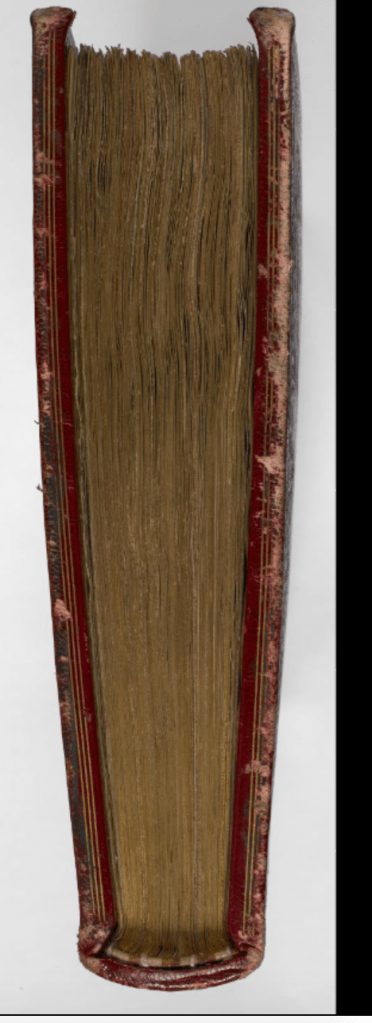
Exhibit F: Binding

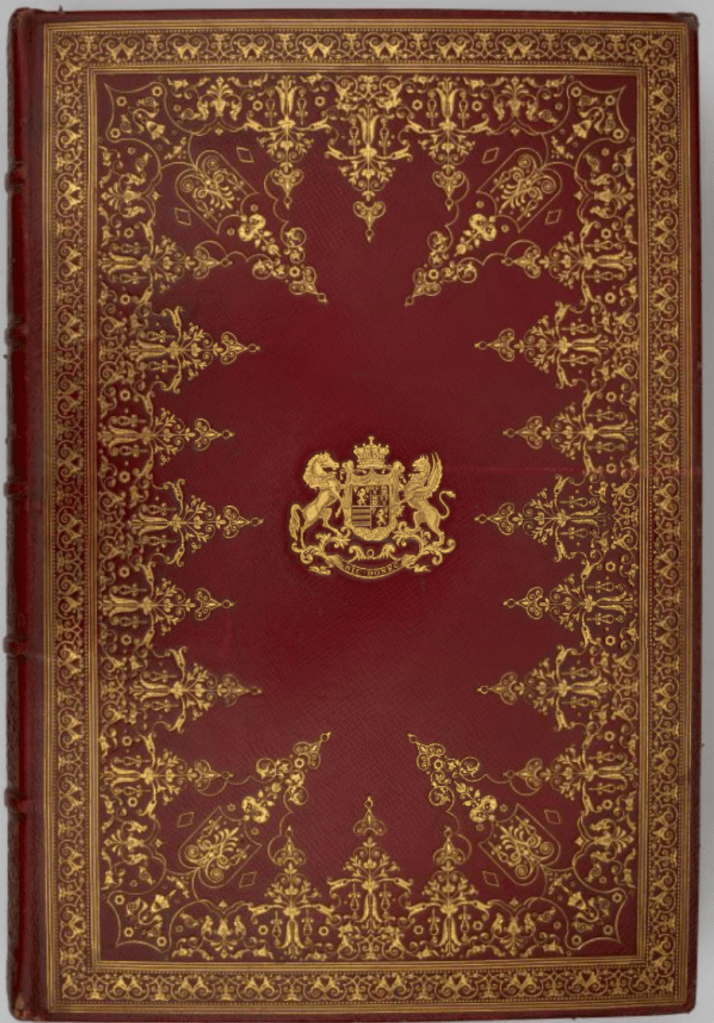
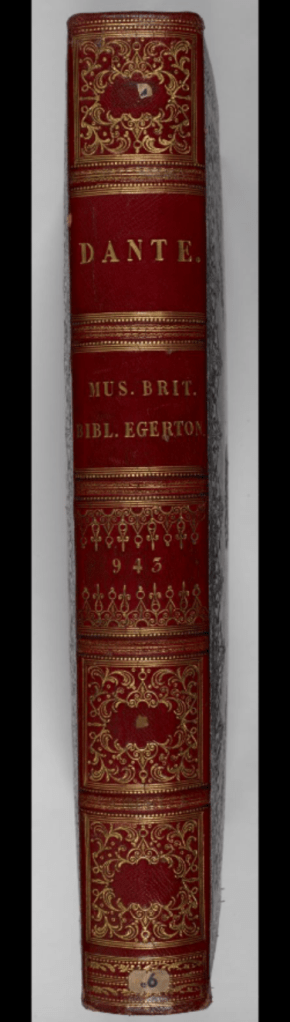
The binding of this manuscript is composed of gold-tooled red leather over wooden boards. In the book, the process of binding that included wooden boards was that the quires would first be sewn, one by one, onto several sewing supports (thongs or cords). The ends of the sewing supports would go into the wooden boards that served as the front and back covers. Finally, the boards would be covered with skin. In this case, it is red leather. Next, the quires would be attached to the sewing supports by suspending the supports vertically on a frame. This manuscript probably had more supports since it was bound later on. Then, the process of sewing the quires on, one by one, would begin.

Gilt edges, Egerton MS 943, f. x-r

In the late Middle Ages, it was common for the skins to be brightly colored. It is also characteristic of medieval bindings that the edges of the boards are even with the edges of the leaves. It appears this is the case for this manuscript as well. This manuscript binding was tooled with gold, a process called blind-tooling. This is the process in which a simple pattern is worked into the leather with a hot metal tool. This binding also has “gilt edges,” which are of the highest quality.

This decoration appears on the binding and seems to be one of the “blind-tooled” gold designs.

Although the binding of this manuscript is characteristic of medieval bindings, it was not completed in the Middle Ages. The medieval period, or the Middle Ages, dates roughly between the years of 476 and 1453 AD. However, this binding is dated post-1600. Therefore, it must have been rebound.

Front cover, Egerton MS 943
Spine, Egerton MS 943

Exhibit C: Diagrams & Illustrations

Diagrams

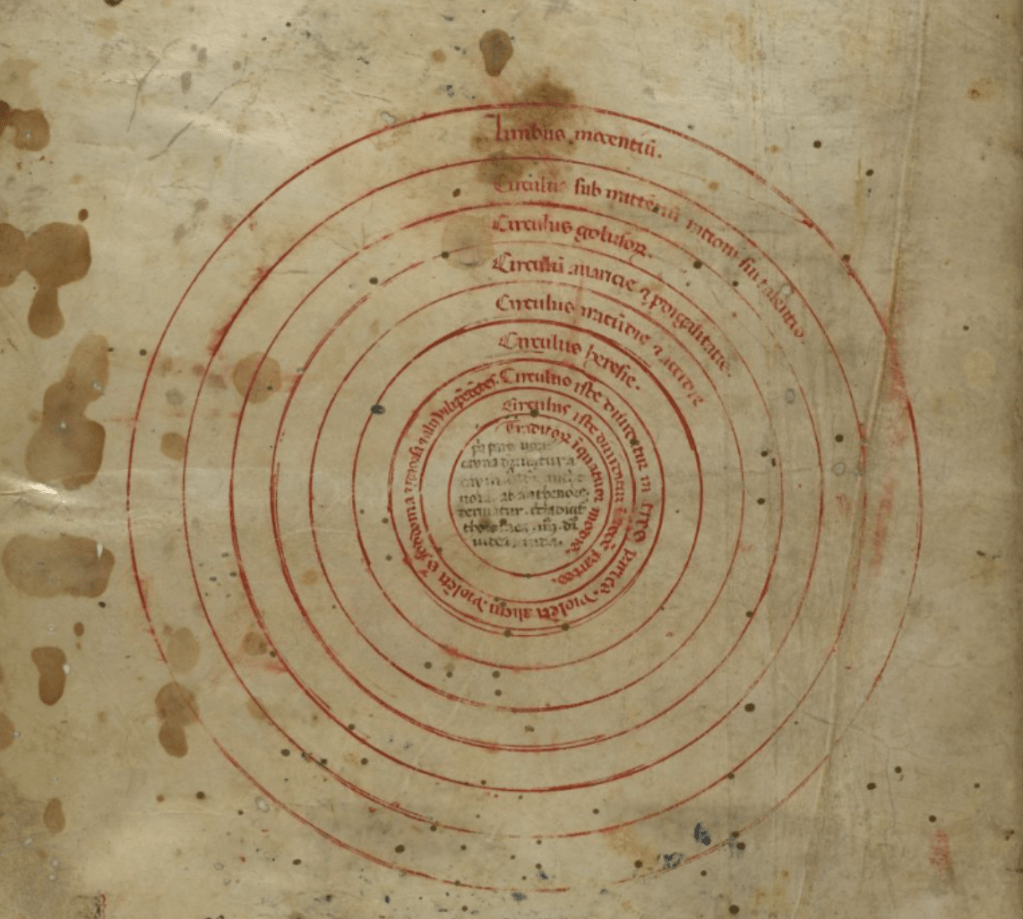
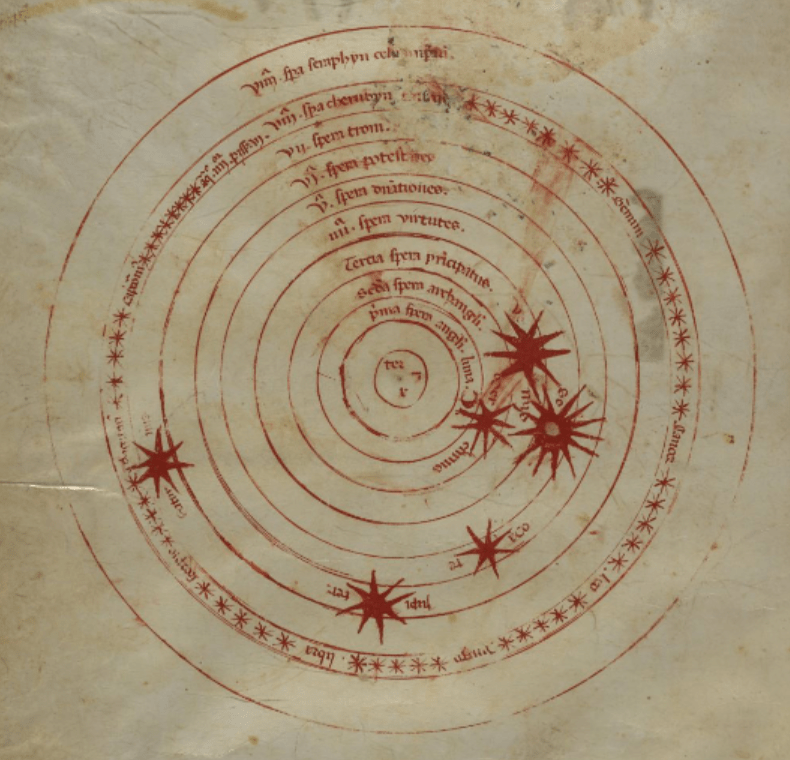
There are two diagrams that appear in this manuscript that are important to understanding The Divine Comedy. One is a diagram of the sphere of Hell, and the other is a diagram of the sphere of Heaven. Both appear in red ink and occupy their own individual pages. The diagram of Hell appears on the page before Inferno, and the diagram of Heaven appears on the page before Paradiso; each diagram depicts the various “spheres,” or layers, that make up each realm. They each serve as a map, or a visual aid, for Dante’s readers to use while navigating through the realms along with him. The first image is the diagram of Hell, which consists of eight concentric circles, each noted by “circulus.” In the poem, there are eight circles of Hell. The second image is the diagram of Heaven, of which there are nine concentric circles representing nine Heavens. The eighth heaven consists of the stars, which are illustrated around the circle. The larger star shapes that appear on the page represent the planets and the Sun.

A diagram of the sphere of Hell in red, Egerton MS 943, f. 2v
A diagram of the sphere of Heaven in red, Egerton MS 943, f. 128v

These diagrams provide insight into the minds of medieval people and how they thought about the physical aspects of Heaven and Hell. However, the manuscript does not include a diagram of Purgatory. Instead, the illustrations from Purgatorio help us understand a medieval perception of Purgatory.

Illustrations

This manuscript contains a lot of illustrations; 261 miniatures to be exact. These appear in line with the text and aim to depict scenes from the text. According to Charles Sarolea, “Most of the artists who tried to follow the Comedy failed” (Preface ix). Although the artist of this manuscript is unknown, Ludwig Volkmann asserts that the miniaturist’s “execution is not very great”(47). Even so, the illustrations that appear throughout definitely contribute to the reader’s understanding of what is going on in the main text, especially being someone who does not know how to read Italian or Latin.

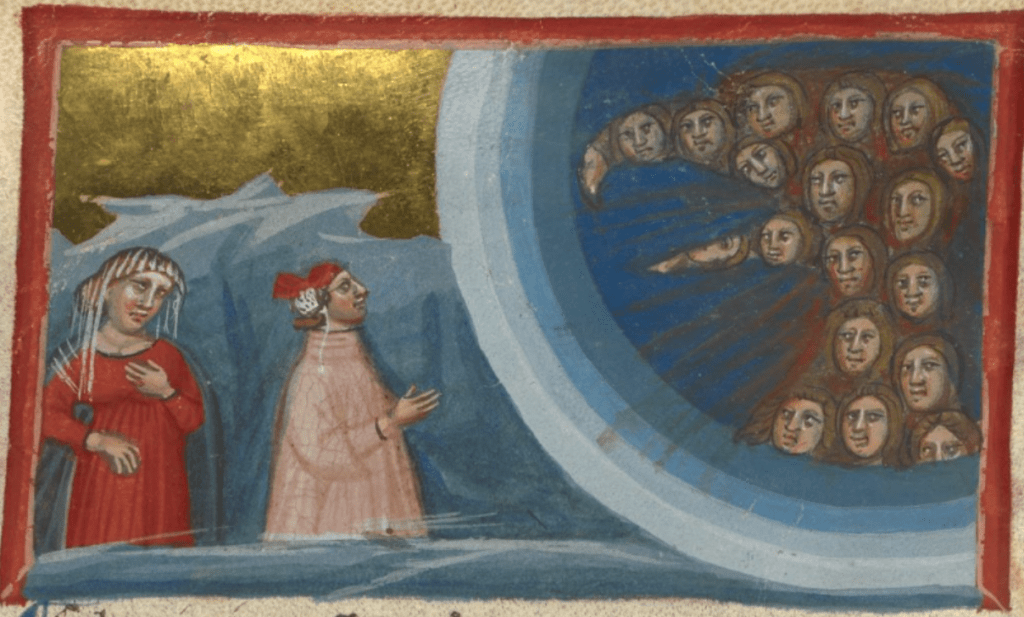
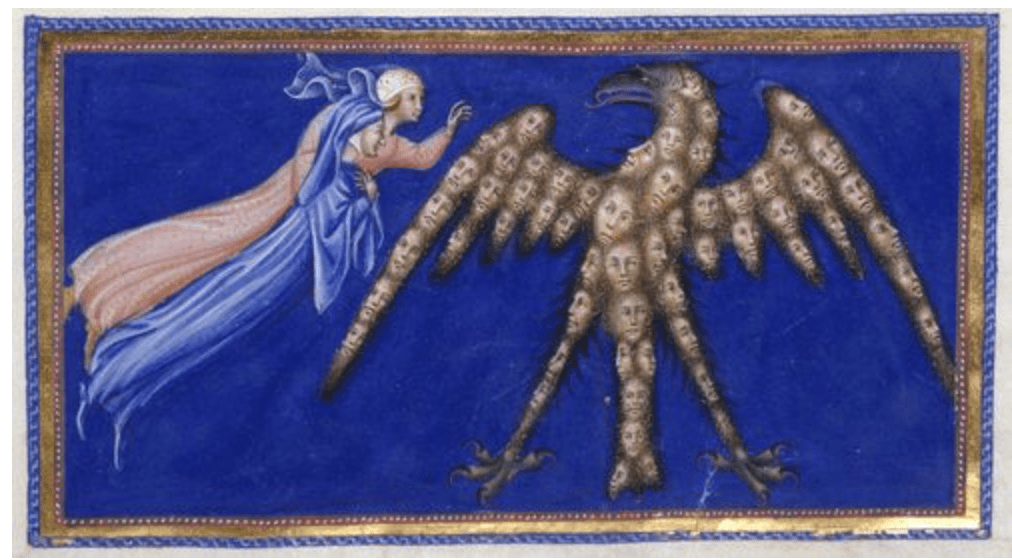
Below is a comparison of two illustrations from two different manuscripts depicting Dante and Beatrice with the eagle of Justice.

Detail of a miniature of Dante and the eagle’s head made up of the souls of just rulers discuss justice, from the Paradiso, Egerton MS 943, f. 160r
Detail of a miniature of Dante and Beatrice before the eagle of Justice, from the Paradiso, Yates Thompson MS 36, f. 162r

As you can tell, the illustration found in my Egerton manuscript is significantly less detailed in terms of human bodies, clothing, the frame of the image, and the eagle. The shape that is supposed to be an eagle does not necessarily look like an eagle but more like a random collage of human faces. In addition, the illustration is very flat compared to the other one, which has an element of depth that makes both the figures of Dante and Beatrice as well as the eagle look like they are coming out of the page. In addition, the lines on the first image are not as distinct as the lines in the second image, which also contributes to the flatness of the image.

The blog post on the British Library website that includes a short introduction and some information about the manuscript I used for comparison, Yates Thompson MS 36, can be found here: https://blogs.bl.uk/digitisedmanuscripts/2013/03/to-hell-and-back-dante-and-the-divine-comedy.html

Exhibit E: Glossing & Commentary

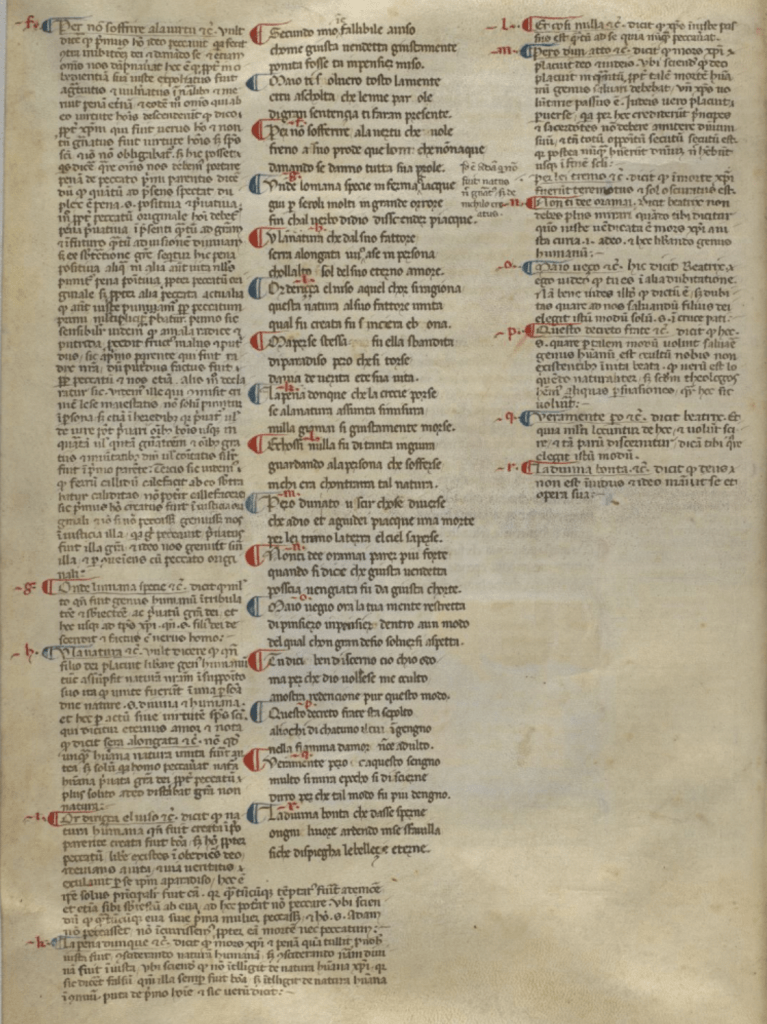
All of the glossing that occurs in this manuscript is in Latin. It appears throughout the entire book up until f. 146v in Paradiso. The glossing that occurs in this manuscript is primarily lexical glossing in the form of Concordance, which uses paraph marks (as seen below) and is organized in alphabetical order (also seen below). Concordance was useful for people living in religious communities who were actively studying the Bible or a particular topic, however, this sort of gloss is useful for this manuscript because it includes so many references to religious beliefs about the afterlife. This type of gloss is also syntactical because it uses letters to indicate the order in which they should be read.

There are both short and longer glosses throughout the manuscript. Each stanza of poetry in the image below has been glossed, matching the commentary in the margins. The glossing appears on both sides of the text on this page and in many others, sometimes taking over the entire page.

Glossing from Paradiso, Egerton MS 943, f. 139v

Exhibit D: Illumination

The illumination work done in this manuscript are attributed to the Master of the Antiphonar of Padua. Illuminations are in gold and appear throughout the entirety of the manuscript. There is illumination in decorated letters, illustrations, and sometimes the text itself. This indicates that this manuscript must have been relatively expensive, in addition to the other components we have discussed. For example, a significant amount of gold leaf must have been used to illuminate the backgrounds of many illustrations in addition to chunks of text.

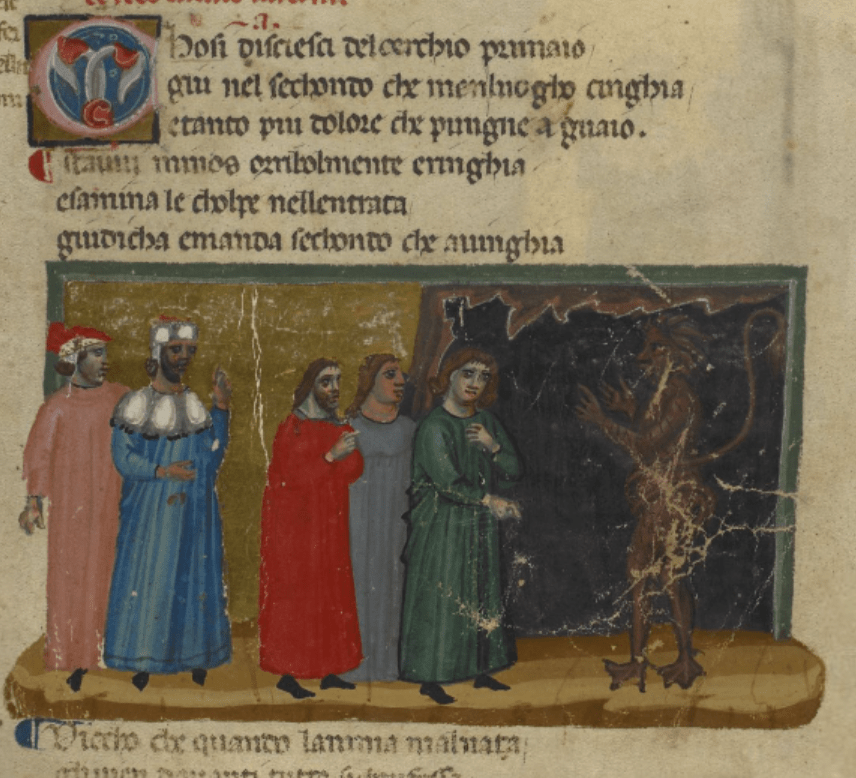
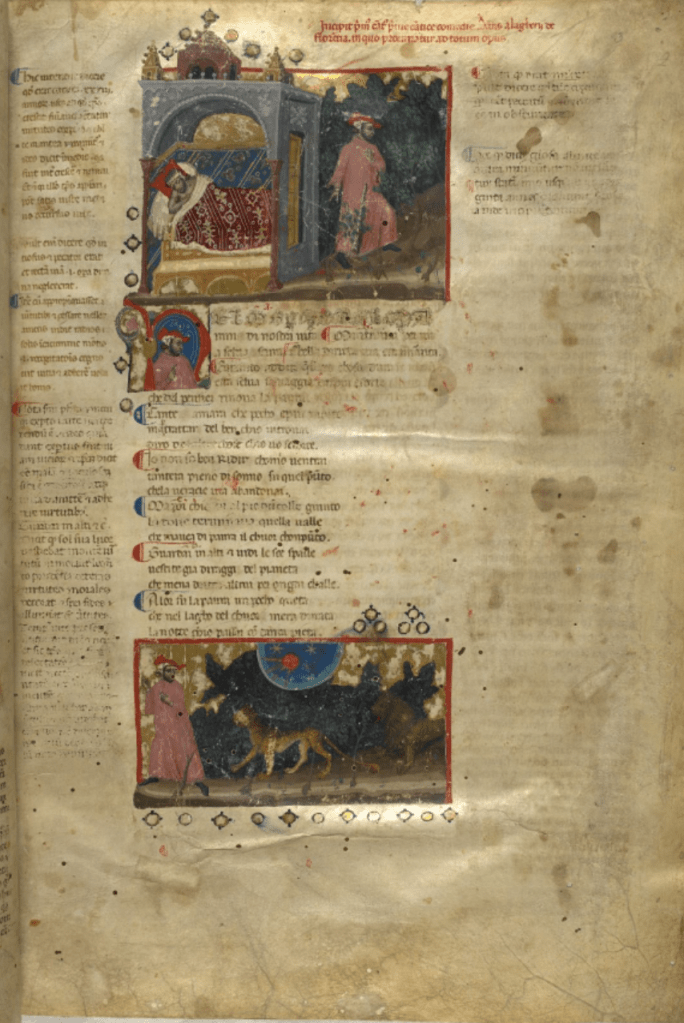
Miniature from Inferno, Egerton MS 943, f. 3r

In the illustration above, the illumination appears in gold behind Dante and Virgil. This contrasts the black background that appears behind the This is an example of the kind of illumination that is characteristic of this manuscript. It often serves as the background in many illustrations.

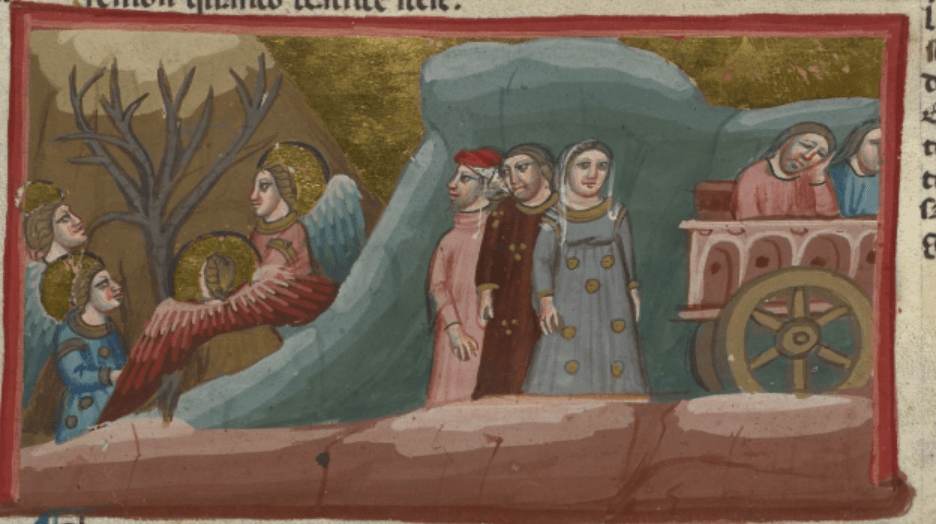
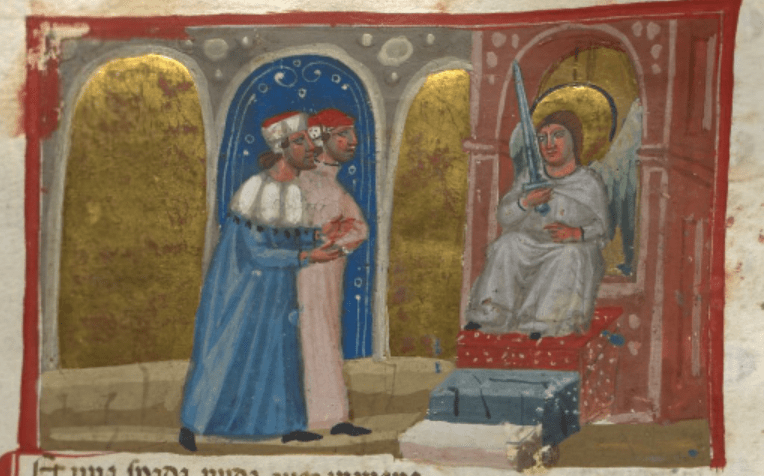
In addition, since this poem incorporates religion, gold illumination frequently depicts things that are deemed holy. For example, gold illumination is used for halos that appear on angels.

Egerton MS 943, f. 122r
Dante and Virgil before the guardian of Purgatory, Egerton MS 943, f. 79r

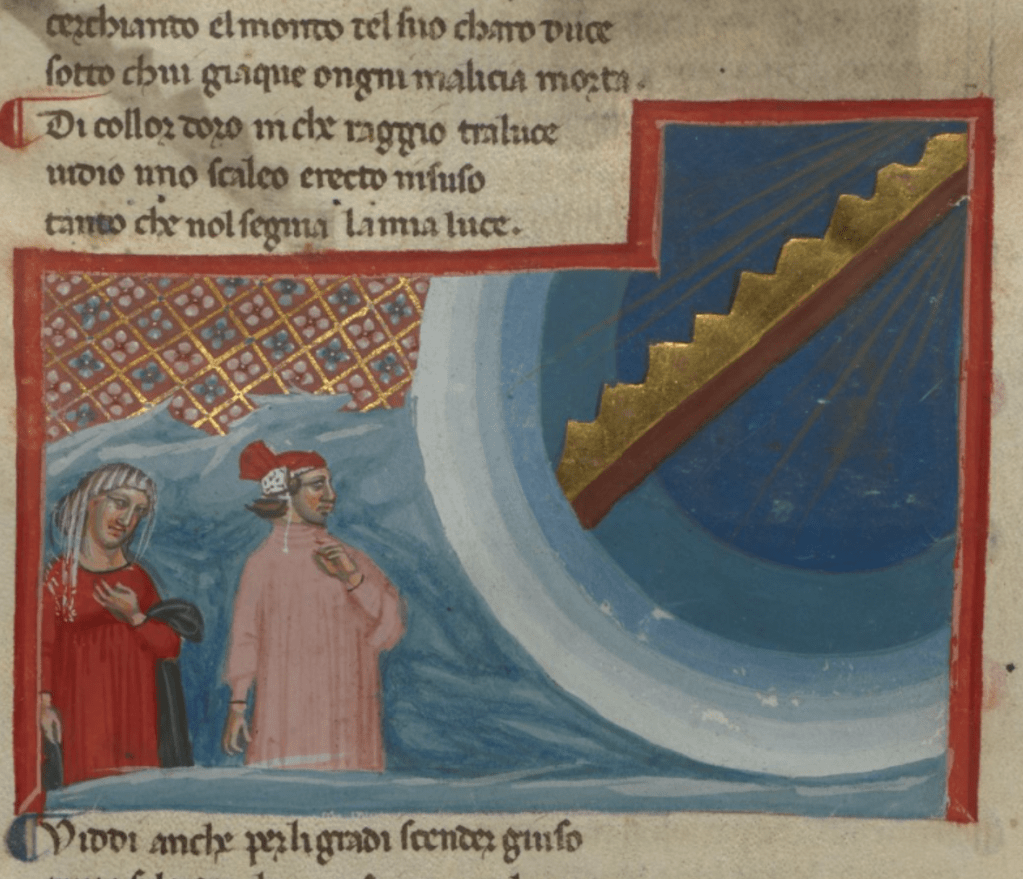
In the image that appears below, the staircase leading up to the seventh Heaven is illuminated in gold. This is meant to be represent a holy staircase, so the illuminated really brings it to the attention of the reader. In addition, there is an elaborate, grid-patterned background that is lined with gold illumination. The design inside consists of red and blue flowers. Please note that when artists illustrated a manuscript, the illumination would come before pigments.

Detail of miniature of Dante and Beatrice looking at the golden stairway to the seventh Heaven: Saturn, from Paradiso, Egerton MS 943, f. 163v

Gold was also used to write some of the main text (pictured below). This differs from the black ink that was used for a majority of the text throughout.

Egerton MS 943, f. 184r

Exhibit G: Handwriting & Transcription

Gothic Book Hand

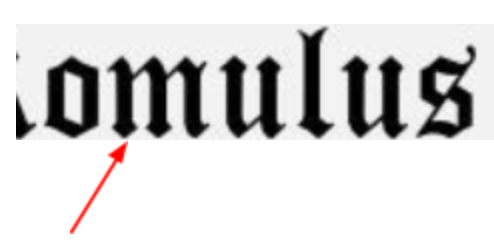
This manuscript is written in the Gothic book hand, which consists of three distinct forms: Praescissa, Quadrata, and Semi-Quadrata, with Praescissa being the highest grade of Gothic and Semi-Quadrata being the lowest. The difference between these three forms is that, one, Praescissa does not use what we refer to as “serifs” at the bottom of letters like the other two forms do. Instead, for letters like “n,” the minims are flat at the bottom. In Quadrata, the foot of each minim has a diamond-shaped serif at the bottom while in Semi-Quadrata, they are only used sometimes. Below, if you look closely at the bottom of each minim in the letter “m,” you will notice a diamond-shape, which is a type of serif used in this book hand.

Screen shot taking from: https://medium.com/@foxxiuxiu/thai-glyph-religion-ux-b55e470162ab

Transcription

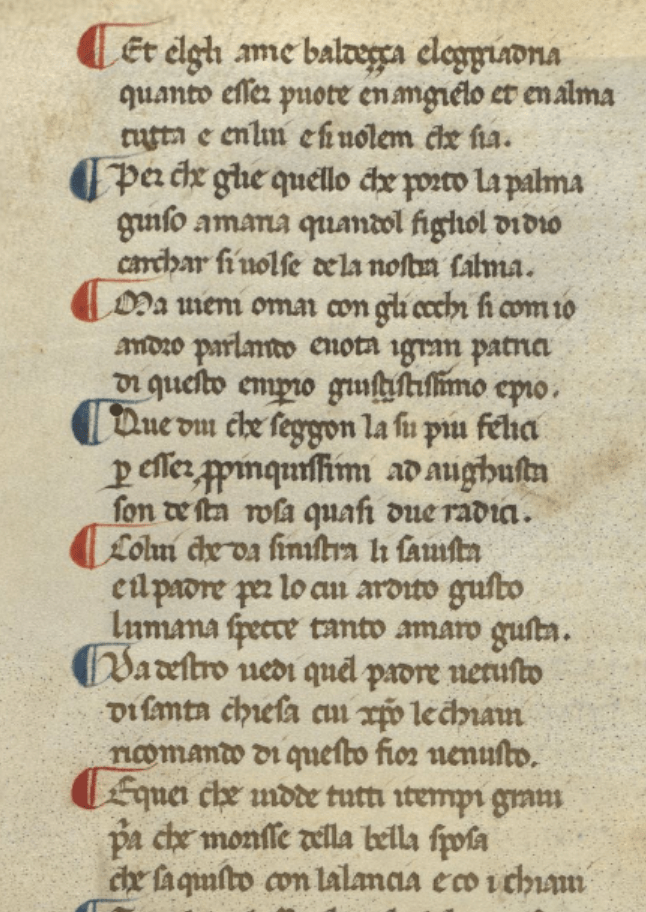
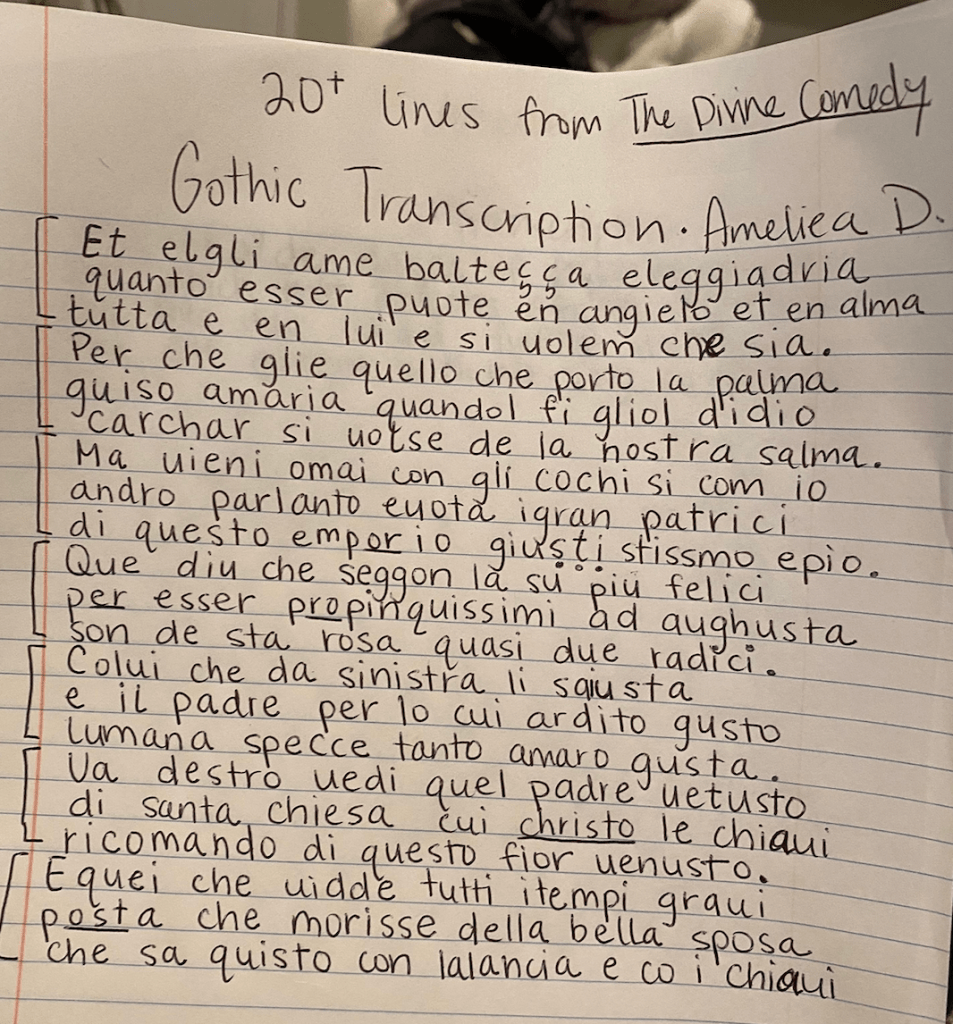
Excerpt from Paradiso, Egerton MS 943, f. 184r

After transcribing this, I noticed a few things. One, the ninth line of text has what is called sub punctuation (the three dots that appear below the baseline under each letter) to indicate that the text has been corrected. Secondly, the last line I transcribed lacked a punctus. I though this was unusual because every other stanza ends with a punctus except for this one. This led me to the conclusion that it may have been either forgotten or damaged.

Modern Version

I decided to make a museum blog in which I am the tour guide through the Egerton manuscript of Dante’s Divine Comedy. The reason I decided to do this was because Dante’s journey through the three realms of the dead is a lot like a tour through museum exhibits. His tour guides are the poet Virgil and Beatrice. As he travels through each realm, the tour guides introduce him to the various things that make up each realm. These are often depicted in the illustrations and Dante seems to me like he observes these things like someone in a museum would. So, I decided to be a tour guide for The Egerton Museum of the Divine Comedy that made a blog to teach potential visitors about the manuscript and what to expect when visiting the museum. I did this by splitting my discussion units (blog posts) into museum exhibits.

Exhibit B: Text & Decoration

The Text

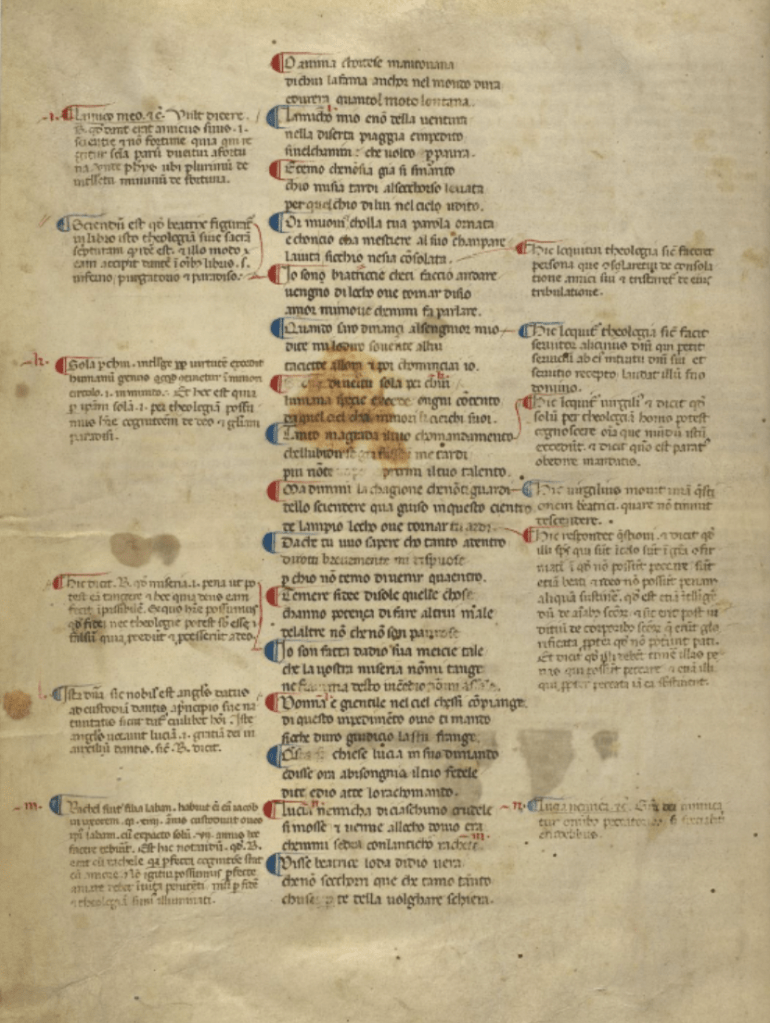
The layout of the text of the poem is “text of the Commedia,” which is one column of 48 lines. The column of text typically appears in the center of the page. Since this is a poem, it contains all of the normal elements that make up a poem, such as verses, lines, stanzas, punctuation, and rhyme scheme. The rhyme scheme of the poem is “terza rima (aba, bcb, cdc, etc.)” (Ricardo Quinones). These three-line rhymes are what make up the stanzas of this poem. Stanza breaks are indicated by paraph marks, which are pictured below in red and blue to the left of the text. In addition, the first letter of each stanza is majuscule (capitalized), and the end of each stanza has a punctuation mark called a punctus, which looks like a modern-day period. This is used to indicate a minor pause in the text. The poem is also divided into 100 cantos, with a canto being a subdivision in an epic poem. As mentioned before, this is an epic poem comprised of three sections (Inferno, Purgatorio, and Paradiso). Therefore, each section contains 33 cantos, with the exception of Inferno, which contains one more that serves as an introduction to The Divine Comedy in general (Ricardo Quinones).

Text of the Commedia, Egerton MS 943, f. 5v

Ordinatio

The term ordinatio refers to the layout of the parts of a text in a manuscript and the methods used to indicate text divisions, such as books and chapters. There are several methods used in this manuscript to help the reader understand how to move through the page.

Rubrication

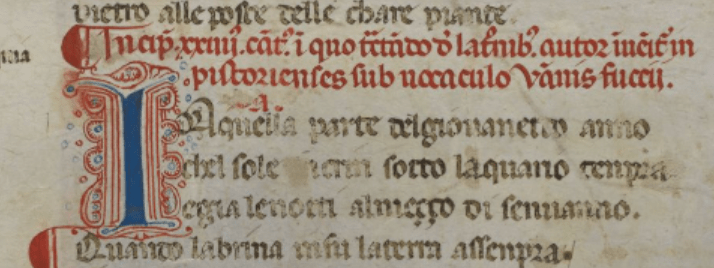
To indicate the different texts, scribes used rubrication, which refers to titles and headings introducing the new text, typically done in a red lead called minium (25). Titles and headings of medieval texts typically begin with the Latin word “Incipit,” which means “it begins/here begins” (Graham and Clemens 24). In this manuscript, the titles of each section of the poem are rubricated as well as the headings for each canto. These indicate to the reader that there is a significant transition happening in the text.

Rubrication title for Inferno, Egerton MS 943, f. 3r
Rubrication heading at the start of a new canto in Paradiso, Egerton MS 943, f. 147r

Decoration

In this manuscript, rubricated titles and headings are followed by a decoration to indicate where the next section or canto begins; usually, in the form of initials.

Initials

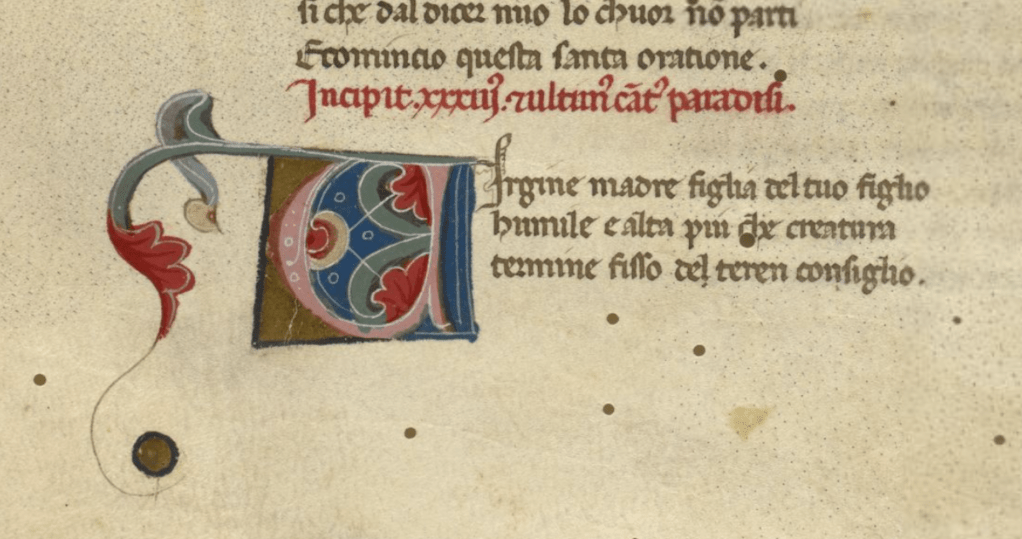
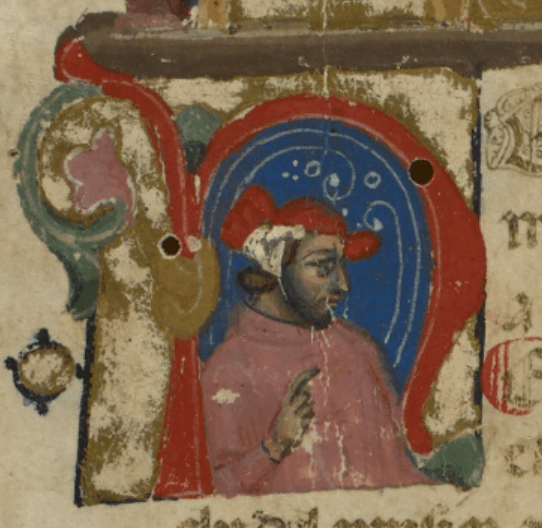
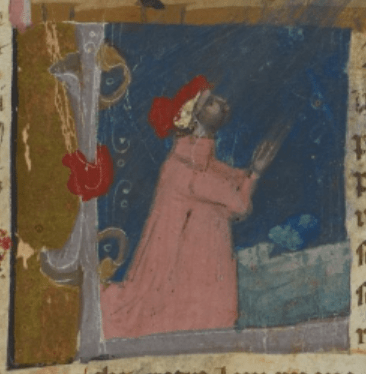
The first type of initial falls within the category of inhabited initials, which are initials that contain either a human or animal figure in it. It is called an anthropomorphic initial, which means a human figure appears in it somewhere. This specific initial pictured below is what is used to indicate the start of the first section of the poem, Inferno. The figure that appears inside of the initial is Dante because he is wearing a pink-colored robe. This is also a foliate initial because it has vine and leaf decorations that extend from it on the left side.

Detail of historiated initial from Inferno, Egerton MS 943, f. 3r

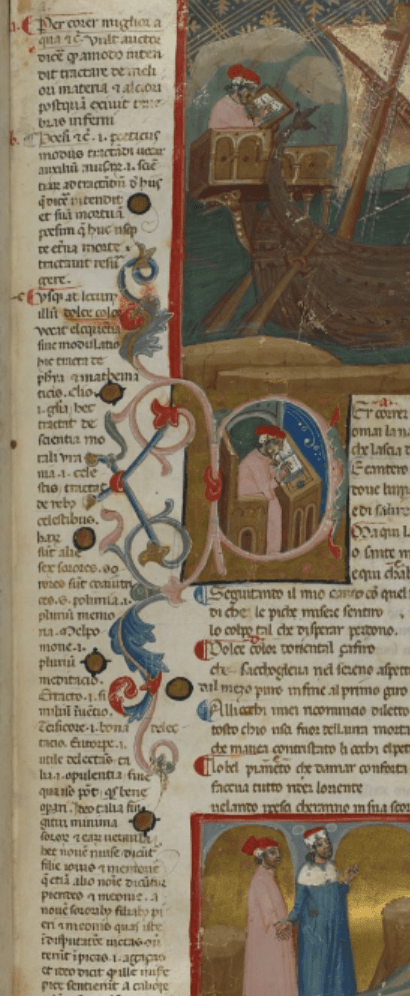
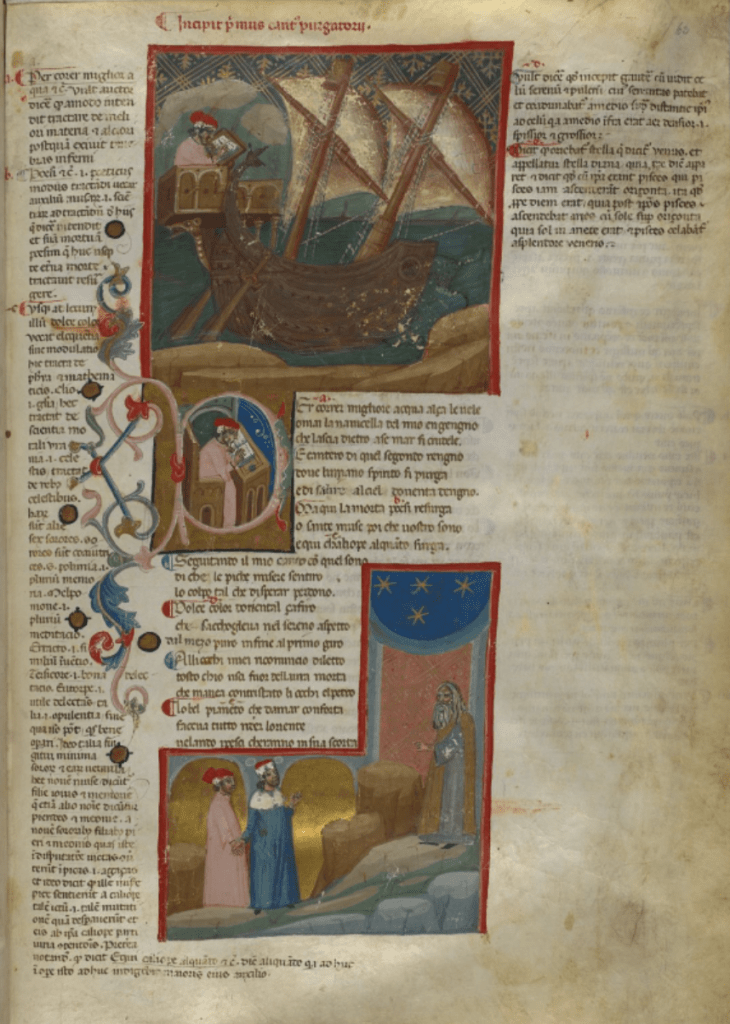
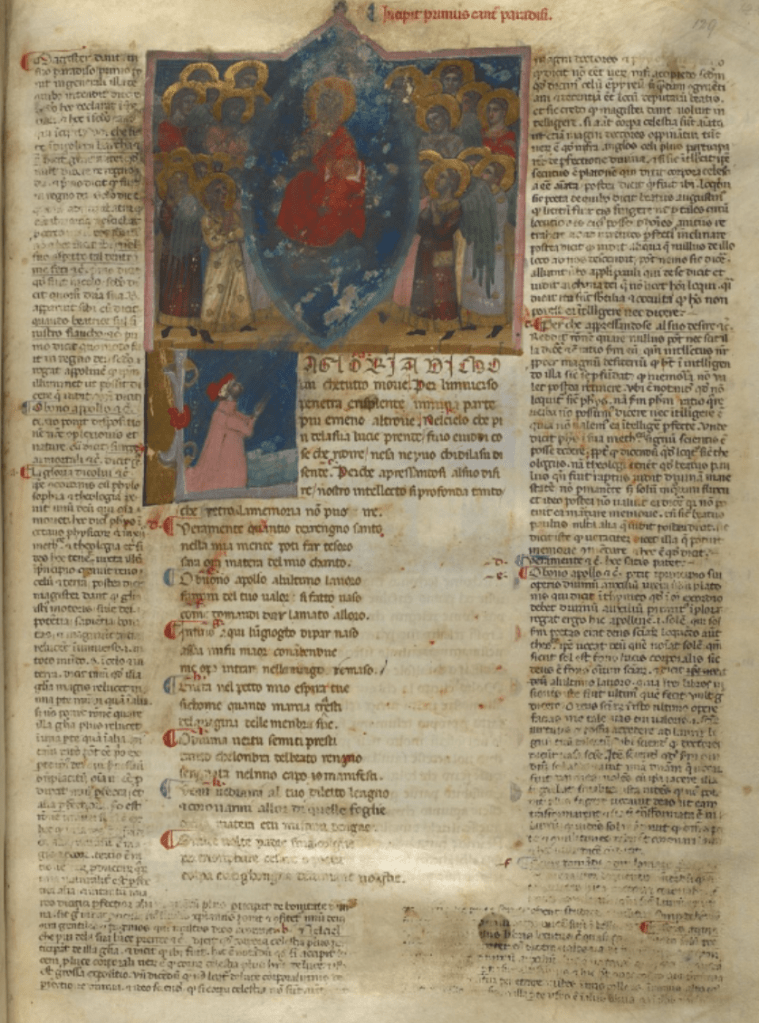
This next two initials fall within the same category, however, they are historiated initials. The difference is that these initials contain a human figure (in this case Dante) that is illustrated doing something that occurs in the text itself. The first image shows the initial that indicates the beginning of the second section of the poem, Purgatorio. Dante is presented like a typical medieval scribe, writing a book (perhaps this book) at a desk. This initial also includes foliate decoration that extends into the margins. The second image shows the initial that indicates the beginning of the third section of the poem, Paradiso. Dante is depicted in a praying position on his knees with his hands clasped together.

Detail of historiated initial with foliate decoration from Purgatorio, Egerton MS 943, f. 63r
Detail of historiated initial from Paradiso, Egerton MS 943, f. 129r

Now that we have some basic terminology, let’s take a look at how these elements contribute to the ordinatio.

Each of these pages has rubrication appearing at the top of the page to indicate the title of the section of the poem. In addition, each also includes an illustration at the top of the page, presumably meant to introduce the opening scene of that section. Next are the inhabited initials, which indicate where the main text of the section begins. Finally, although the text layout on these pages slightly differ from the standard column, the paraph marks provide the reader with the correct order.

Another category of initials are decorative initials, which are initials in a text that do not have figures in them. In this manuscript, these are used to indicate the start of a new canto. The image below is one example called a pen-work initial, in this case, a littera flourisha because it is done in red and blue colors that differ from the ink of the main text. This specific letter that appears below is blue with red pen-work decoration. It is also a litterae notabiliores because it is bigger and more noticeable than others on the page.

Decorative initial in blue ink with red decoration, Egerton MS 943, f. 42v

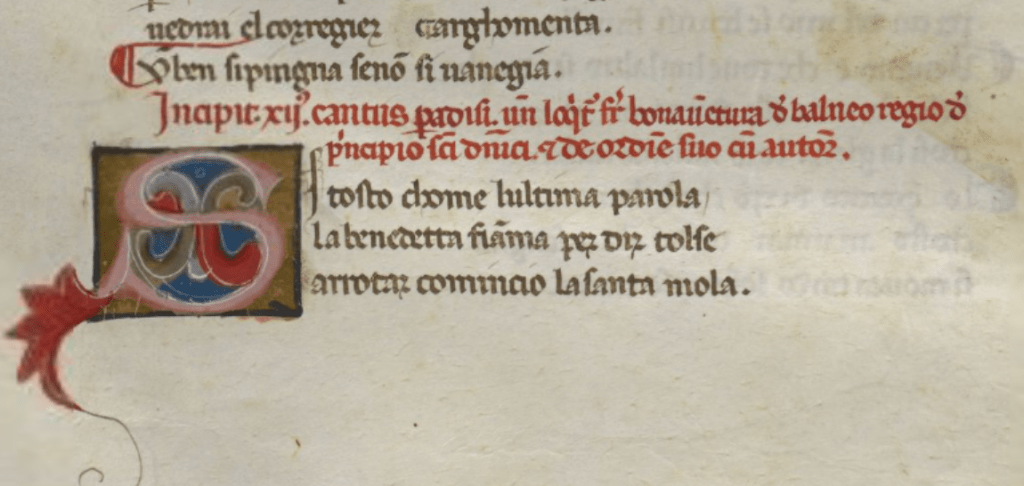
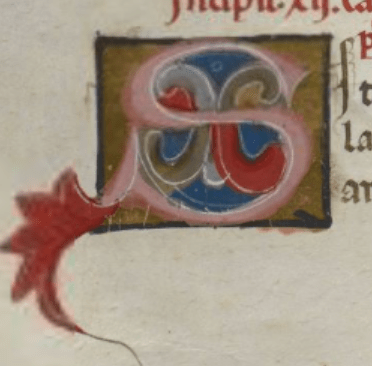
Another example of a decorated initial is pictured below; it is also a foliate initial.

Foliate initial “S” from Paradiso, Egerton MS 943, f. 147r

Exhibit A: Physical Description

Materials

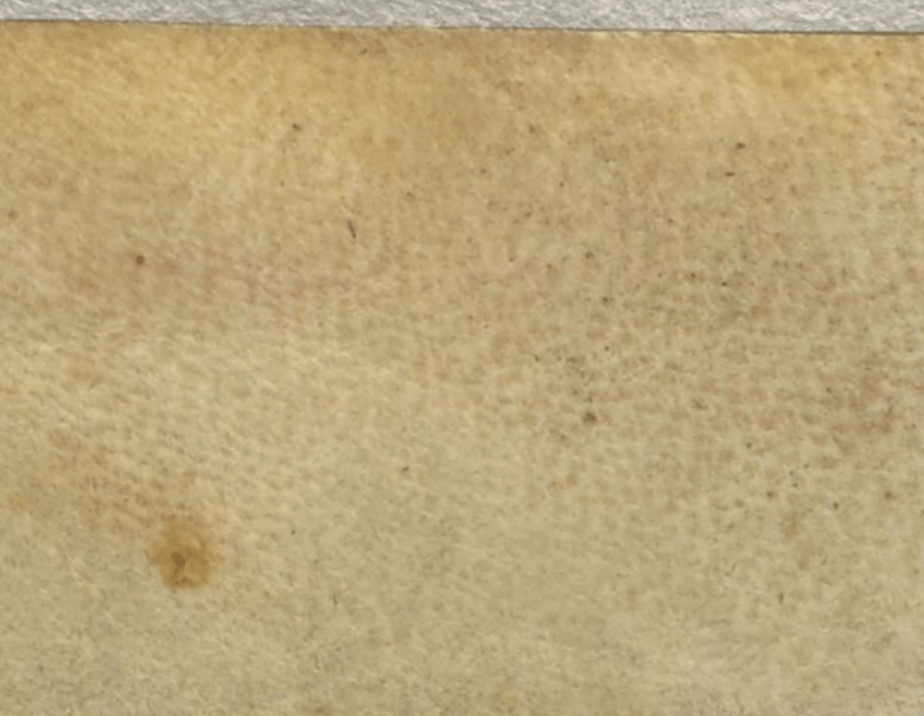
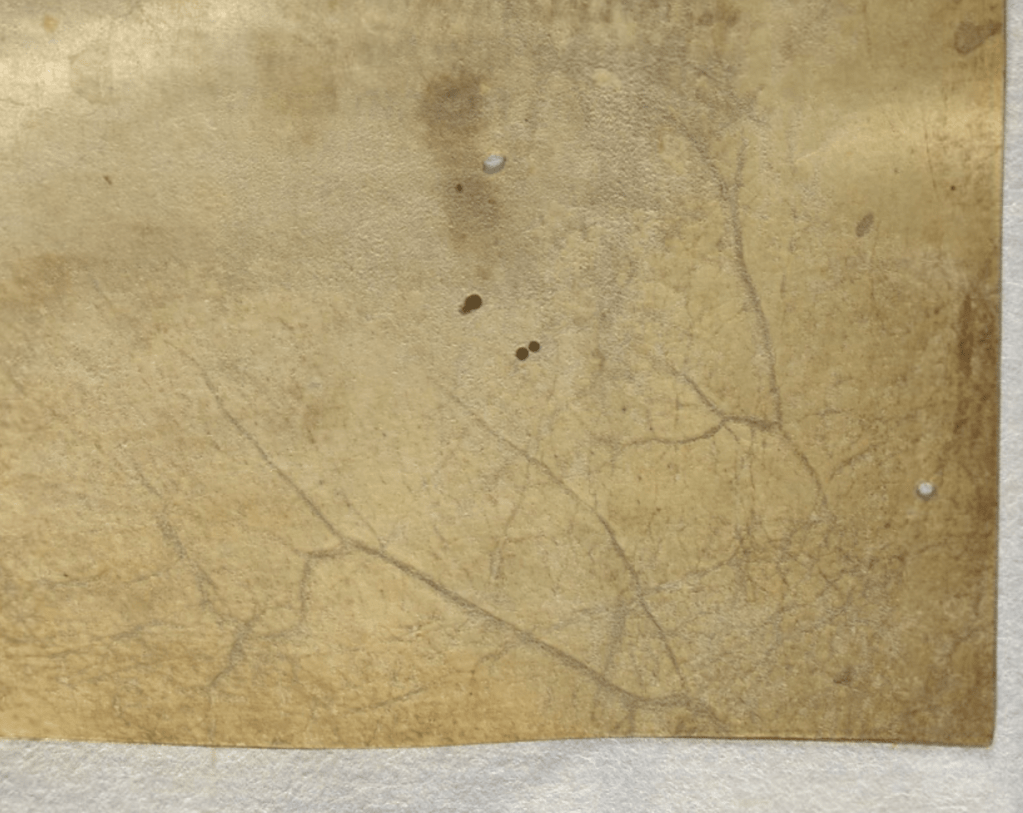
A majority of medieval manuscripts were written on parchment, or a writing surface made of animal skins (Graham & Clemens 9). This was probably made of goat skin since those were the most common in Italy and Greece. This manuscript is primarily made of parchment but also includes some paper. In order to differentiate parchment from other writing surfaces, you can look at evidence that appears on the hair-side and the flesh-side. For example, the hair-side of the parchment often has what is called “peppering,” or little dots where hair follicles used to be (14). This can be seen in the first image below. The second image shows veining that may appear on the flesh-side of parchment.

Evidence of peppering that appears on f. 3r, Egerton MS 943
Evidence of veining that appears on f. 3v, Egerton MS 943

Structure

Foliation

One folio, or leaf, consists of one recto and one verso. Today, a folio would be a single piece of paper with the recto being the front side, or the front page, and the verso being the back side, or the flip side of the page (Graham and Clemens 3). The term foliation refers to how the leaves of a manuscript are constructed and how someone wrote the folio numbers. Unlike page numbers, folio numbers appear only on the front side of a leaf. For example, instead of being page 1 followed by page 2, folio 1 consists of folio 1r (recto) and folio 1v (verso).

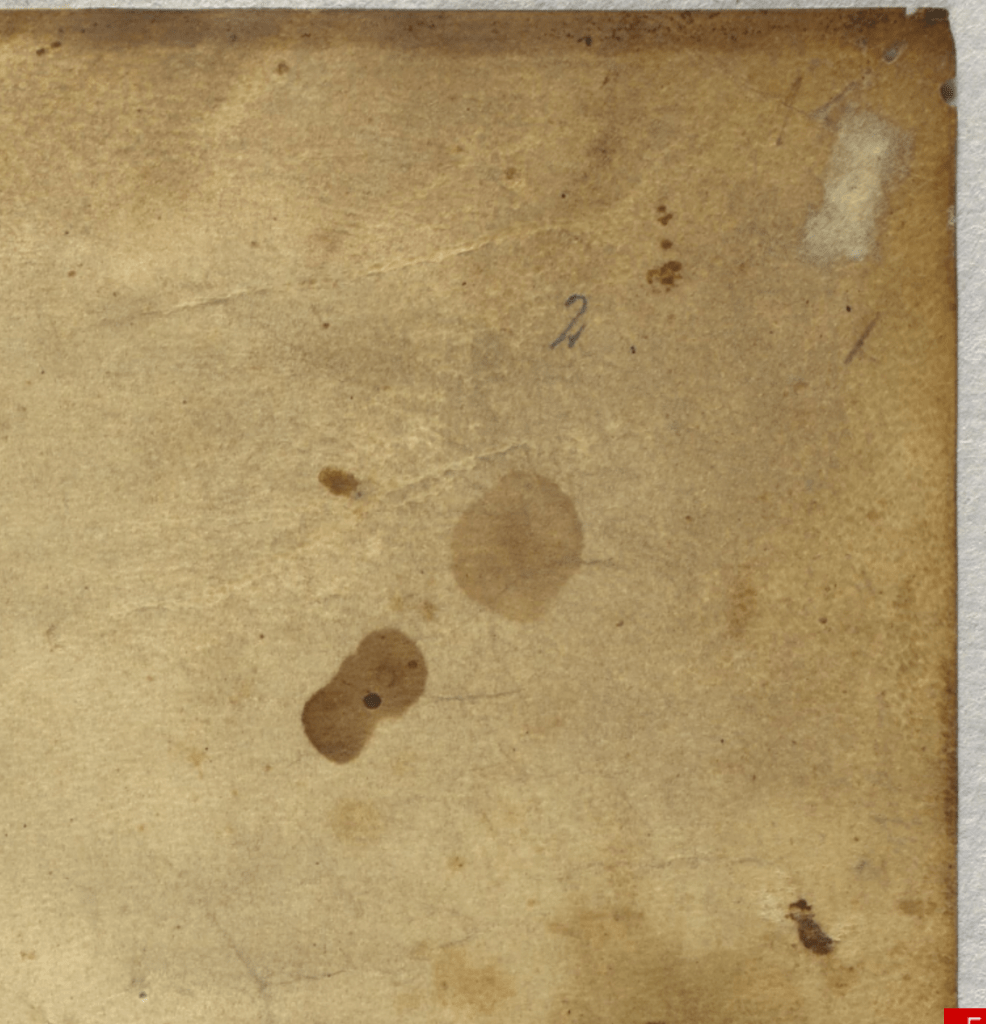
Folio number probably written in pencil that appears in the right corner of f. 2r, Egerton MS 943

La Divina Commedia consists of a total of 188 folios. That would be 376 “pages” of a novel in today’s terminology. Folios 2v-62r make up Inferno, folios 63r-126r make up Purgatorio, and folios 129r-186r make up Paradiso. Folio 1 is an added paper leaf. Folio 188 is constructed of a parchment flyleaf plus one paper. There are also 2 parchment and 1 paper flyleaves at the beginning, and 2 parchment and 1 paper flyleaves at the end, all unfoliated. The other folios are made of parchment.

Collation

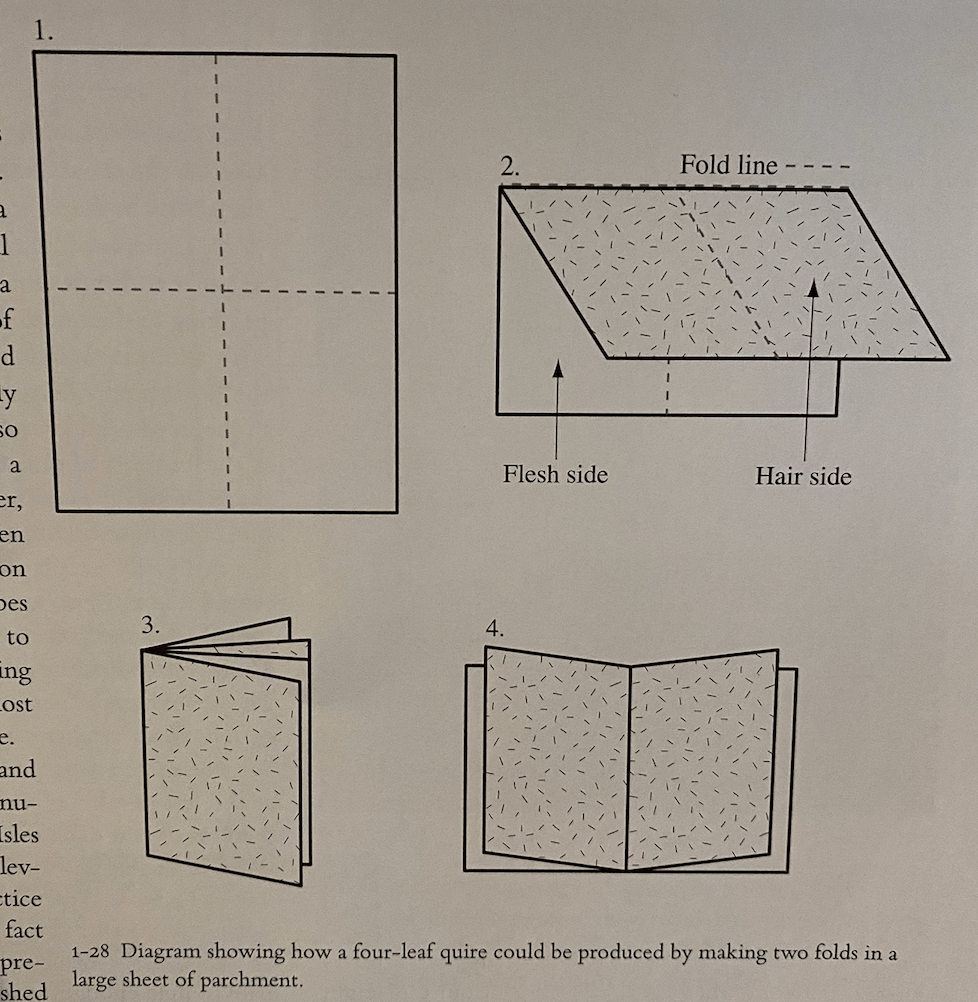
A quire is the result of folding together multiple sheets of parchment or paper to form leaves that are eventually linked together to form a book. A bifolium is one sheet folded in half; the plural is bifolia. The term collation refers to how the quires of a manuscript are arranged, how many quires there are, how many bifolia make up each quire, and how they are foliated. Quire sizes varied in the Middle Ages, but the most common quire structures were eight or ten leaves (14).

This is a diagram of a four-leaf quire structure from Graham and Clemens (15).

This manuscript consists of 19 quires of differing sizes. Folios 3-122 make up quires 1-12, each consisting of 10 leaves. Folios 123-128 make up quire 13 and consist of 6 leaves. Folios 129-178 make up quires 14 through 18, each consisting of 10 leaves. Folios 179-186 make up quire 19. This specific quire is peculiar because it is a quire of 8 leaves that was probably originally a quire of 10, with the last two leaves excised. The last folios 187 and 188 are two single parchment leaves.

Design a site like this with WordPress.com
Get started