The Egerton Museum of The Divine Comedy is the museum of the medieval manuscript Egerton MS 943 titled La Divina Commedia. The manuscript was originally created in Northern Italy in either Emilia or Padua during the first half of the 14th century. It now resides in the British Library in London thanks to it being purchased in 1842 with the Bridgewater fund for 12,000 euros. The manuscript is written in Italian and includes commentary in Latin.
Dante Alighieri
“Never was there a poet who possessed to an equal degree the eye of the painter.”
Sarolea, Charles. From the Preface to “The Pictorial Presentations in Dante’s Divine Comedy” by Ludwig Volkmann (vi)
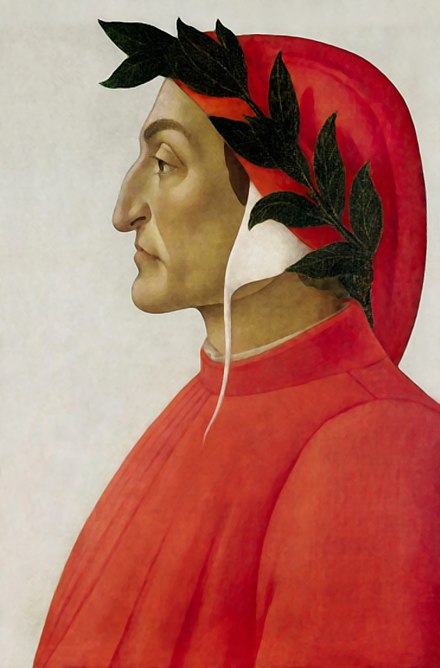
La Divina Commedia was written by Dante Alighieri, who became a very famous Italian poet in the late Middle Ages. According to Ricardo Quinones, it took Dante more than ten years to write the epic, and its influence has carried on over the course of more than 650 years. Dante’s Divine Comedy is a long narrative poem, or epic poem, that consists of three parts: Inferno, Purgatorio, and Paradiso. The section Inferno refers to Hell, Purgatorio refers to Purgatory, and Paradiso refers to Paradise, or Heaven. Although this is not a religious text, it does incorporate many religious ideas about the three realms of the dead. The basis of the poem is Dante’s journey through each of the realms led first by the Italian poet Virgil through Hell and Purgatory and then by Beatrice, who was Dante’s ideal woman, to Heaven. Before touring the exhibits, we recommend that our visitors watch these videos that summarize the plot of each of the three sections.
Size
The manuscript’s dimensions are 390 x 260 mm. In order to better understand the size of this manuscript, it has been compared to the size of an iPad and a standard sheet of paper below. In this image, a normal sheet of paper is seen in yellow with its size being 297 x 210 mm, the manuscript is depicted in green with its size being 390 x 260 mm. Finally, the iPad is on the right with its size of about 243 x 13 mm. So, the manuscript is significantly bigger than an iPad and a good bit larger than a standard sheet.

What’s Inside
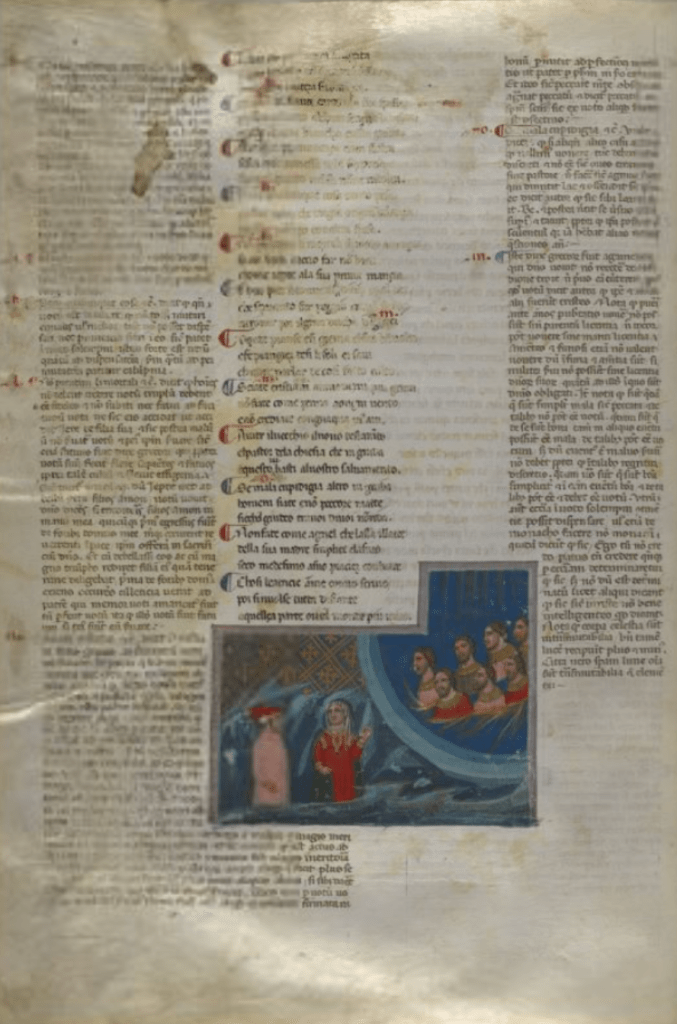
In addition to the main text, other things that can be found throughout this manuscript are illustrations (261 small miniatures in gold and color), circular diagrams of Heaven and Hell, gold illumination, rubrication, large decorated and inhabited initials, Latin commentary in the margins, and more. Each of these are exhibited throughout the museum, in addition to the materials and structure of the manuscript.
“The ‘Divine Comedy’ is not only the summa of all the wisdom of his time, it is not only a chronicle of local and general history, it is, moreover, a marvellous gallery of pictures and a museum of sculpture.”
Sarolea, Charles. From the Preface to “The Pictorial Presentations in Dante’s Divine Comedy” by Ludwig Volkmann (vi)
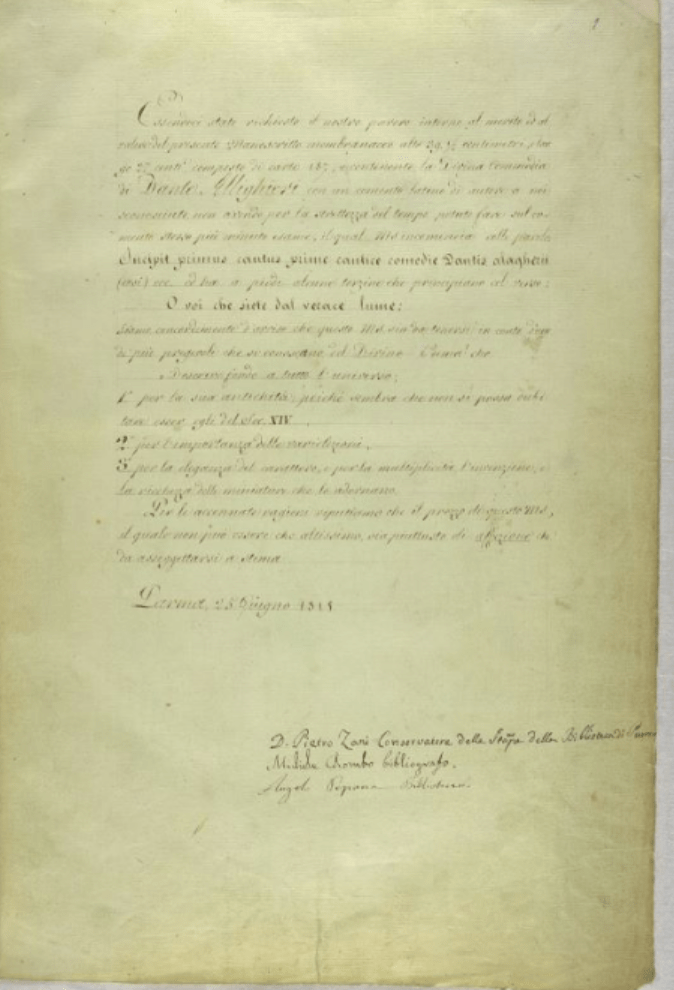
Towards the beginning of the manuscript, there is a certificate of its value that was signed in June of 1815 by D. Pietro Zani and two others at the Library of Parma.
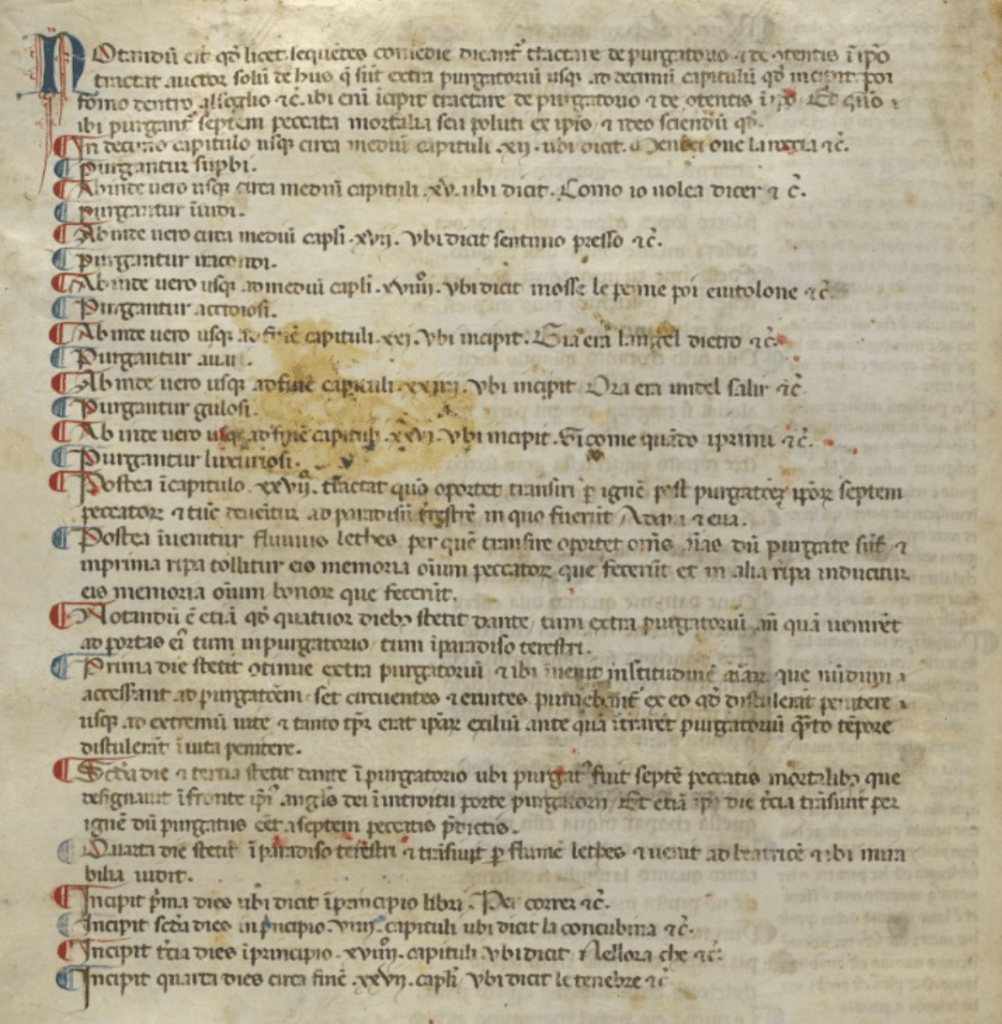
Before the start of Purgatorio, there is a chapter list; the only one included in the poem.
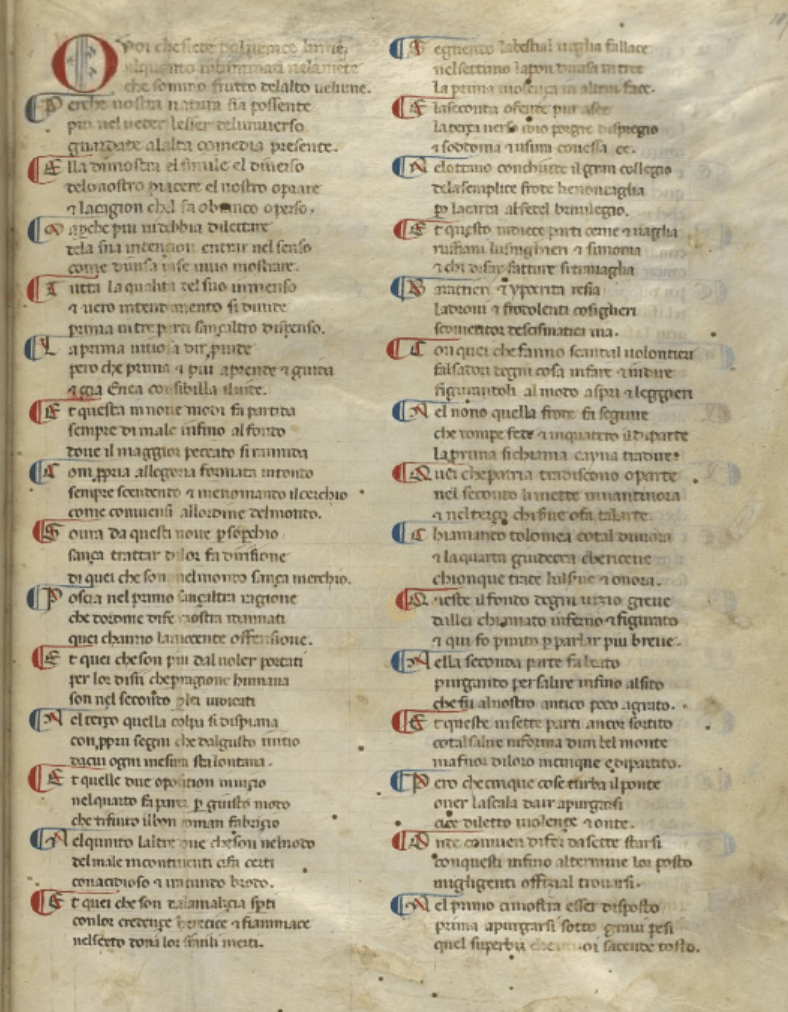
At the end of the manuscript, there are added verses by Jacopo Alighieri (Dante’s son) that serves as a sort of introduction to his father’s work.
Physical Damage
This manuscript is quite damaged. Many of its pages contain evidence of water damage, stains, fading, and ink deterioration. Some of the columns of text are so damaged that they cannot be read. The commentary in the margins has also experienced a significant amount of damage, with whole chunks of text missing. In addition, two of its pages were excised from the Paradiso section. Although there are also several indications that the text had to be corrected, the damage is so intense that much of it cannot be fixed.
What are its functions?
Dante’s poem explores the ideas about the afterlife by creating a fictional journey through the realms. The ideas that are used to tell this story come from medieval Christianity. In the Middle Ages, religion shaped the way people lived their everyday lives, so it is not a surprise that this would become a very popular work despite the fact that works of literature were only just beginning to gain popularity at the time.
 Divina Commedia