Besides the amount of detail used in creating these images, the illustrations in this manuscript do seem to attempt to depict what is described in the main text of the book, almost like a story book. Below are a number of miniatures from throughout the manuscript, paired with my analysis. For the fully digitized version, follow this link: http://www.bl.uk/manuscripts/FullDisplay.aspx?ref=Egerton_MS_943
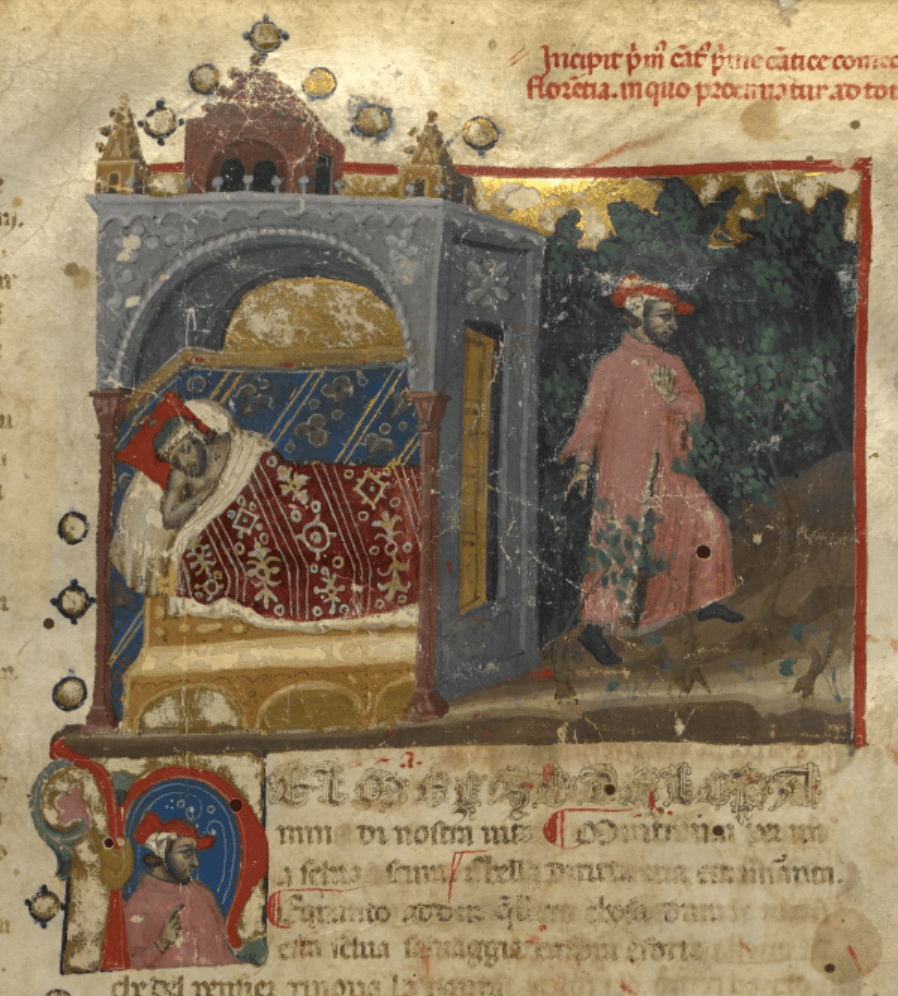
This is the first miniature that appears in the manuscript. By looking at this illustration, we learn a lot about what to expect moving forward. For example, it introduces the main character, Dante, and allows us to differentiate between Dante and other characters that appear in later illustrations. The image caption describes the scene as Dante asleep in his bed and his soul leaving his body. His soul, then, must be the figure that appears to be a man wearing a pink, or lighter shade of red, colored robe. The color of Dante’s clothing is what will help us recognize him in the following miniatures.
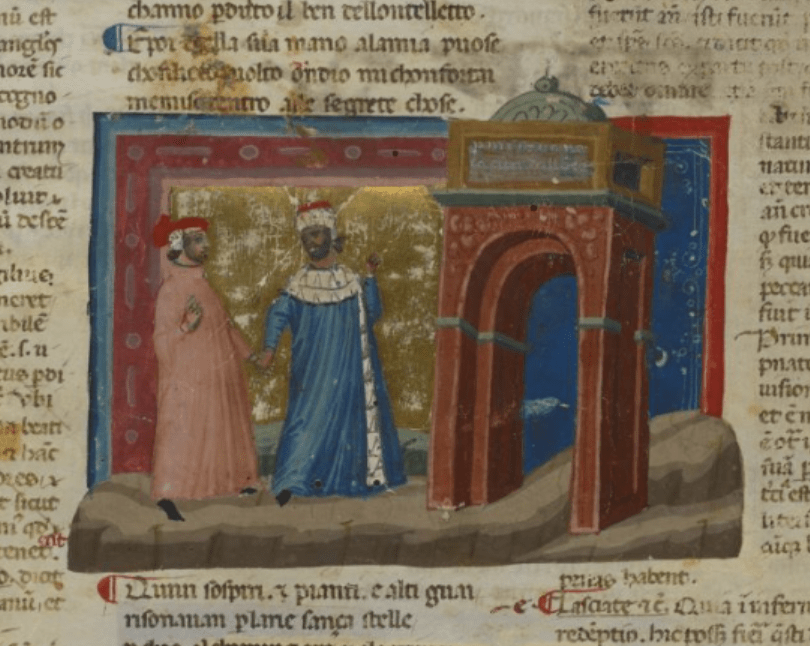
Many of the illustrations throughout this manuscript use the colors red and blue. Other colors used are usually different variations of red and blue, such as a lighter shade of blue or red. One that is used a lot is a pink shade. Dante’s robe, for example, is pink while Virgil’s is blue. In this, Virgil is about to lead Dante through the gates of Hell. The two figures are holding hands, indicating they are about to embark on a journey together. The red, arch-shaped doorway appears to be the “gates” of Hell. There does seem to be an attempt to depict depth in this image, specifically where the artist created a stone pathway beneath the two figures’ feet that is not even. There is little space in this image, however, which may lead to a misinterpretation.
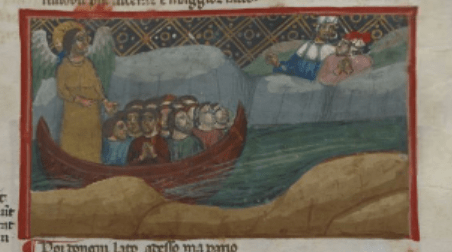
The image above appears in Purgatorio. In the first three folios of Purgatorio, there are two illustrations of boats. The beginning of this section depicts Dante on a sailing boat writing a book, and now, it depicts a boat as the way–at least how Dante thought–souls were brought to Purgatory. The figure of an angel is indicated by wings and an illuminated halo. One thing that is interesting about the illustrations of “souls” in this book is that they look like regular humans. It does not seem like there are any differentiating factors to indicate that they are souls and not humans. This may give us insight into what Dante (and other medieval people who read this) thought their souls would be like when they died. Moreover, many of the illustrations that appear in this section seem to depict many Earthly qualities. For example, there are images of bodies of water, rocks, valleys, and mountains. This depiction of Purgatory is not so different from today, as seen in the film The Lovely Bones.
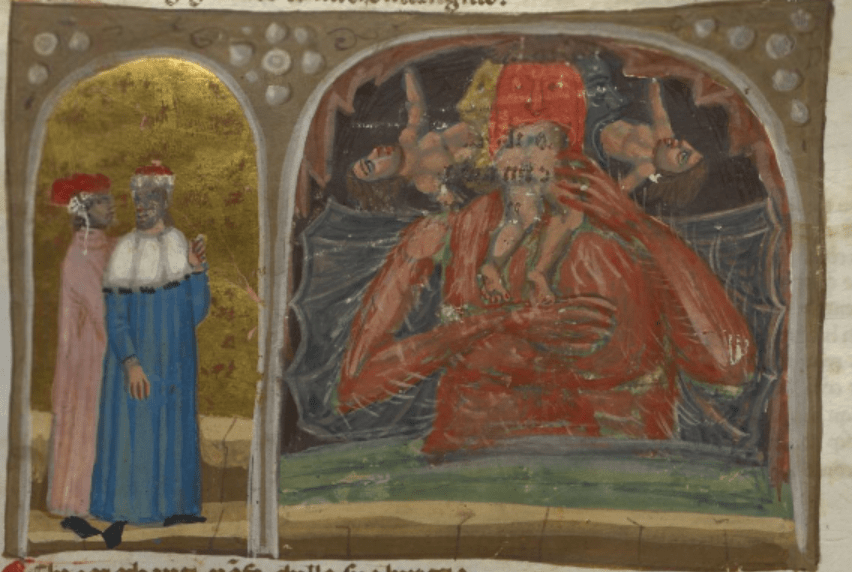
This illustration depicts Dante and Virgil watching Lucifer (the big, red object on the right) devour human souls. Virgil is looking at Dante, however, not Lucifer. He seems to be instructing Dante about this part of Hell. Throughout Inferno, the two seem to move through the circles of Hell, stopping to look at each part as if Virgil is giving Dante a literal tour of Hell. Lucifer is depicted with three heads: one is gold, one is red, and one is black.
 Divina Commedia